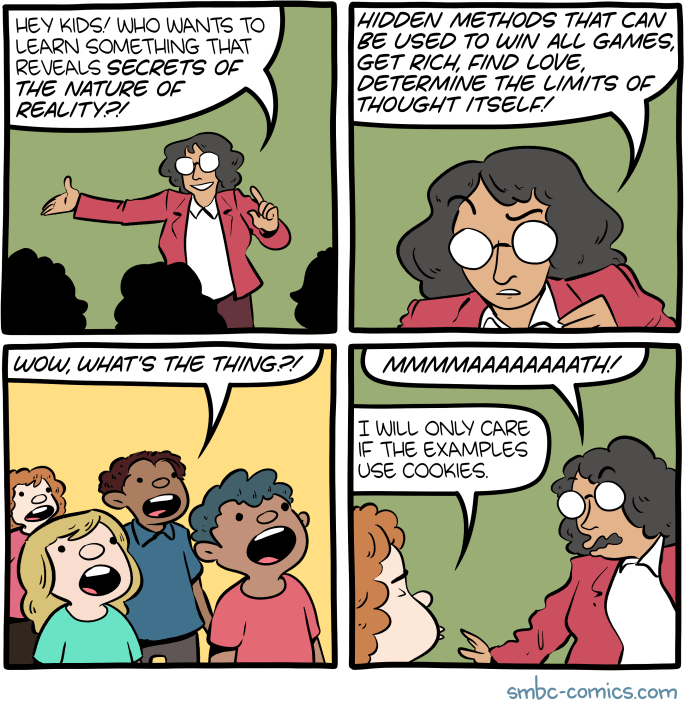
SMBC: The universality of mathematics, but not notation

This is pretty good, and it will exercise your mind for a minute. Source: Saturday Morning Breakfast Cereal The distinction between mathematical notation and its underlying reality is a crucial one.  The first is an invention of humans, the second is universal.  In fact, I've increasingly become convinced that the second actually is the universe, … Continue reading SMBC: The universality of mathematics, but not notation →

SMBC: What if the universe is made of math?

I loved this SMBC.  It echoes something I've observed before, that some physicists have disdain for philosophy, while often engaging in it themselves. Hovertext: "Philosophy is dumb, unless it comes out of the mouth of a physicist." Click through for full sized version and red button caption. via Saturday Morning Breakfast Cereal. I've discussed the question before … Continue reading SMBC: What if the universe is made of math? →

Steven Weinberg’s new book on the history of science

Jerry Coyne has a post up discussing Steven Weinberg's new book on the history of science, including an exclusive excerpt: Steven Weinberg’s new book on the history of science (with excerpts) « Why Evolution Is True. The portion of the excerpt that spoke most clearly to me was this passage near the end: Science is not now … Continue reading Steven Weinberg’s new book on the history of science →

Is logic and mathematics part of science?

Last week was scientism week at Scientia Salon, and I reblogged a post by Coel Hellier on a defense of scientism, mostly by arguing that mathematics was actually part of science.  As I indicated in my comment on that reblog, while I agree with Coel that both logic and mathematics have foundations that are empirically … Continue reading Is logic and mathematics part of science? →

Logic has empirical foundations, sort of.

Massimo Pigliucci has an interesting post at Scientia Salon on philosophical zombies.  Massimo looks at David Chalmers's argument for philosophical zombie arguments and, I think, does an excellent job at showing the problems with them.  But in the discussion, a distinction is made that I find interesting. Apparently, Chalmers admits that zombies are probably not naturally … Continue reading Logic has empirical foundations, sort of. →

Max Tegmark and MinutePhysics on the mathematical universe

This is a subject that we've discussed repeatedly here, so I thought you might find Tegmark's narration of this video interesting. http://www.youtube.com/watch?v=HGG4HmlotJE I'm pretty sure that mathematics are not only something humans created, that they are based on relations we observe in the world, but beyond that, I remain largely agnostic on the Mathematical Universe Hypothesis … Continue reading Max Tegmark and MinutePhysics on the mathematical universe →

Tegmark’s Mathematical Universe Hypothesis

I recently read Max Tegmark’s latest book, ‘Our Mathematical Universe‘, about his views on multiverses and the ultimate nature of reality.  This is the fourth and final post in a series on the concepts and views he covers in the book. The previous entries were: Tegmark’s Level I Multiverse: infinite space Tegmark’s Level II Multiverse: bubble universes … Continue reading Tegmark’s Mathematical Universe Hypothesis →