E. E. “Doc” Smith’s Lensman series is classic space opera.
As a science fiction nerd, I’m actually a bit embarrassed to admit that I had never read it before. Part of the reason was only discovering it as an adult, and finding the opening of the official first book in the series, Triplanetary, to be both cartoonish and a massive infodump. It seemed like the series was one of those things I probably would have loved as a boy, but had found too late to enjoy.
Recently I stumbled across a recommendation, that new readers of the series skip the first two books, which are actually prequels. The advice was to begin with Galactic Patrol, read forward from there, and only look at the prequels afterward. This makes some sense. Often it’s best to read books in the order they were written (even when authors claim otherwise). Galactic Patrol was the first book written in the series, and begins a four book arc with the same characters. (The main story of Triplanetary was written first, but not as part of the Lensman series. It was only later retconned into it.)
So the recommended order is:
- Galactic Patrol
- Gray Lensman
- Second Stage Lensman
- Children of the Lens
And then (if desired) the prequels:
- Triplanetary
- First Lensman
A few weeks ago I discovered that many of Smith’s books are on Gutenberg, available for free.
(If you haven’t discovered it yet, Gutenberg is a pretty amazing resource. You can download public domain books in various ebook formats, including ones you can send to your Kindle or e-reader of choice. Highly recommended)

The content for most of these books is actually pulled from the original serialized versions in Astounding magazine, I imagine for copyright reasons. Reading the unvarnished originals had an appeal to me. Reportedly Smith revised the later editions in the 1950s, but at least for the opening chapters of Galactic Patrol, I didn’t notice much of a difference. And the Gutenberg ones seem transcribed far more carefully than many of the bad OCR scans available on Amazon.
But the writing is very much a product of its time and shows its pulp origins. The language is clumsy and amateurish by today’s standards. The characters, at least in Galactic Patrol and Gray Lensman, are basically just stereotype placeholders. And the dialog is stilted and banal. Except for the dialog between the hero and his love interest, which starts off just cringe inducing. It doesn’t help that Smith projects 1930s gender roles into the far future. And his portrayal of human organizations and relations is hopelessly simplistic. Things improve in the later books, particularly the last one, written several years after the others, but don’t expect high literature.
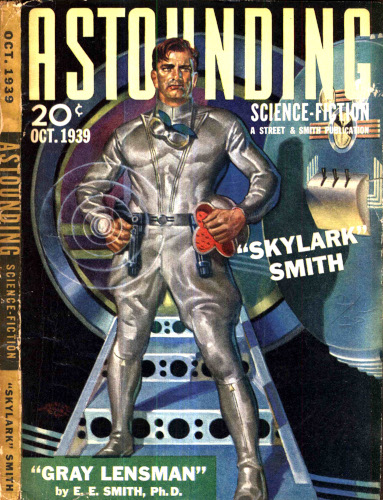
What’s the appeal then? This series is basically the Star Wars of its day. Before there were Jedi, there were Lensman, superhuman warriors equipped with an alien tool that give them telepathic powers. And before there were the Vorlons and Shadows of Babylon 5, there were the Arisians and Eddorians, two advanced civilizations using other species as proxies in their ancient war. Before there was a Death Star, there were weapons that could smash planets into each other, and even destroy stars by the end of the series. And before there was the melange of Dune, there was thionite, a fatally addictive drug only available on one planet in the galaxy, Trenco, with a hellish environment.
So Smith makes up for crude writing with sheer imagination and action. The story moves along at a lightning pace, mainly because he doesn’t concern himself with only writing in scenes. After struggling with the opening chapters, I found myself drawn in for the ride. I can see why early science fiction fans enjoyed the series. (Which honestly was my main reason for reading it.)
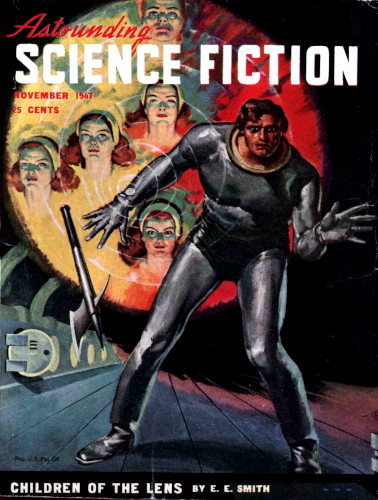
That said, I was periodically thrown out of the story. The hero, Kimball Kinnison, is portrayed as perfect, with no flaws. He’s part of an organization that authorizes him to be judge, jury, and executioner. The galactic patrol is also pretty much perfect. It has no resource constraints or politics in its organization. And the Arisians, the aliens providing the superpowers, have no flaws. All of this is presented without humor or irony. (Kinnison’s perfection is eventually explained as the result of eugenics, presented in a positive light.)
The saving grace is that the villains are no pushovers. They’re generally portrayed as extremely intelligent, brave, and competent, although often with a hubris that leads to their undoing. They’re so competent I often found myself wondering what their motivations were supposed to be. Smith only tangentially gets into their goals, other than just doing dastardly stuff.
A lot of the villains are whole species with a sour disposition. We meet a succession of evil species, where the only solution is to wipe out the whole lot. Which is where the planet destroying weapons come into play. But the ethics of specioside are glossed over.
So again, these stories are very much a product of their time. This extends to a lot of anachronistic technology. “Computer” refers to a man doing calculations; although the electronic variety do show up in the later books. Battles are tracked with gigantic “tanks”, 3D displays showing the movement of ships among stars and planets. Everything is recorded on tapes, even far into the future. And the word “plate” is used where “screen” or “monitor” is typically used today, while “screens” itself seems to mean shields. All reminders that much of this was written before TVs were common.
I’ve read the series through Children of the Lens. Not sure if I’ll do the prequels, at least not right away. The books are well worth checking out for anyone interested in the history of the sci-fi genre. But I’m not sure how comfortable I am recommending them for just straight entertainment. At this point they’re pretty dated, both in terms of science and social attitudes, and heavily geared toward a male audience. Still, if you can approach them understanding when and where they come from, they can be an interesting read. And while there isn’t much from Smith’s writing I’m tempted to emulate, his quick action narratives are worth examining.
Have you read the Lensman series? Or any of Smith’s other books? If so, what did you think?
 SelfAwarePatterns
I read those books so long ago (50+ years) I cannot remember whether I liked them or not! :o(
I have often claimed that there are two kinds of fiction: those books that are well-written (and lack much story) and those which emphasize story and are not particularly well-written. (There are a few which are both.)
These books were at the beginnings of the SF genre and very often had great stories, poorly written (and I include the Good Doctor in that category, as well as Sir Heinlein). I still favor story over style, but I don’t have to choose too much between them anymore, which is nice.
LikeLiked by 1 person
Generally I’m with you. I have a high tolerance for low quality writing, if the story is at least fun. And I actually prefer simple straightforward language to the flowery stuff, which is just annoying when the story is otherwise lame. But there are limits, and these books are right on the boundary for me, partly, I think, because it isn’t just the writing itself, but issues with the characters and society portrayed.
You’re right that most of what came out in the early pulps was pretty rough. But I have no trouble enjoying Edgar Rice Burroughs, Robert E Howard, Edmond Hamilton, Walter Gibson, and many others, despite their issues. Smith’s characters just seem particularly flat and wooden, at least in his writing before World War II. Children of the Lens, published in 1947-48, is a more enjoyable read.
LikeLike
I read all of the authors you list, and when I re-read them now, I find them less than enjoyable. Either I suffer from “been there, done that” or I have experienced better story telling and writing (mostly by female authors for some reason (C.J. Cherryh, Michelle West, Martha Wells, etc.)).
LikeLike
I definitely notice how poor the writing is when I go back to their stuff now, which I never did as a boy. But if I hadn’t read it before, or if it’s been a long time, it still mostly works. I recently read one of the Tarzan books I’d missed as a boy, and still enjoyed it. Admittedly I didn’t enjoy it as much as I once did.
LikeLike
> I have a high tolerance for low quality writing, if the story is at least fun.
Then don’t start writing. I’ll kill that for sure.
LikeLiked by 1 person
I have done writing, but not as much as I would like. It does make me notice the writing itself, but usually I can still enjoy stuff that’s far from perfect. I do think a lot about how I might do it differently.
LikeLiked by 1 person
To work, man! To work! There’s no excuse but the excuse. Own it and move on.
LikeLiked by 1 person
Yeah, my job, blah blah blah. I know, I’m full of it.
LikeLiked by 1 person
@selfawarepatterns.com I watched the anime series back in the 90s. Maybe it's time to rewatch and take a look at the books.https://en.wikipedia.org/wiki/Galactic_Patrol_Lensman
LikeLiked by 1 person
Remote Reply
Original Comment URL
Your Profile
Why do I need to enter my profile?
This site is part of the ⁂ open social web, a network of interconnected social platforms (like Mastodon, Pixelfed, Friendica, and others). Unlike centralized social media, your account lives on a platform of your choice, and you can interact with people across different platforms.
By entering your profile, we can send you to your account where you can complete this action.
@selfawarepatterns.com I did read at least a few of them about 30 years ago. They were dated even then, even for someone who grew up on Heinlein, Niven, Clarke, et al. What I remember most is the torture scene where someone is gone at with a cigar trimmer. This is when I learned that I can get so into the narrative that I feel pain in the story. Other than that? Yeah, you're pretty much spot on with the epic levels of the storyline.
LikeLiked by 1 person
Remote Reply
Original Comment URL
Your Profile
Why do I need to enter my profile?
This site is part of the ⁂ open social web, a network of interconnected social platforms (like Mastodon, Pixelfed, Friendica, and others). Unlike centralized social media, your account lives on a platform of your choice, and you can interact with people across different platforms.
By entering your profile, we can send you to your account where you can complete this action.
@selfawarepatterns.com read them decades ago and just downloaded the Gutenberg versions for a reread
LikeLiked by 2 people
Remote Reply
Original Comment URL
Your Profile
Why do I need to enter my profile?
This site is part of the ⁂ open social web, a network of interconnected social platforms (like Mastodon, Pixelfed, Friendica, and others). Unlike centralized social media, your account lives on a platform of your choice, and you can interact with people across different platforms.
By entering your profile, we can send you to your account where you can complete this action.
@selfawarepatterns.com In as much as I've read of his books (Skylark of Space, Skylark Three, Triplanetary), I basically agree. I'd add that he manages to quickly sketch out aliens with interesting enough quirks in a rather Star Wars-like manner. Also the datedness of the tech includes using searchlights because the early novels predate public knowledge of radar (let alone IR sensors)!
LikeLiked by 1 person
Remote Reply
Original Comment URL
Your Profile
Why do I need to enter my profile?
This site is part of the ⁂ open social web, a network of interconnected social platforms (like Mastodon, Pixelfed, Friendica, and others). Unlike centralized social media, your account lives on a platform of your choice, and you can interact with people across different platforms.
By entering your profile, we can send you to your account where you can complete this action.
@selfawarepatterns.com They are enjoyable, but you do have to keep reminding yourself that the bulk of it first saw publication in the 1930s and 1940s based on ideas Smith was toying with as early as 1918. It's a fun set of stories and an important text for the origins of space opera as a genre, but when I recommend it to anyone, it's with a load of caveats. I did a reread of the whole series in May of this year for the first time since the 90s.
LikeLiked by 1 person
Remote Reply
Original Comment URL
Your Profile
Why do I need to enter my profile?
This site is part of the ⁂ open social web, a network of interconnected social platforms (like Mastodon, Pixelfed, Friendica, and others). Unlike centralized social media, your account lives on a platform of your choice, and you can interact with people across different platforms.
By entering your profile, we can send you to your account where you can complete this action.
@selfawarepatterns.com Total agreement. Some of the imagery in the books is fantastic, but then balanced with a society that at this point feels almost alien.
LikeLiked by 1 person
Remote Reply
Original Comment URL
Your Profile
Why do I need to enter my profile?
This site is part of the ⁂ open social web, a network of interconnected social platforms (like Mastodon, Pixelfed, Friendica, and others). Unlike centralized social media, your account lives on a platform of your choice, and you can interact with people across different platforms.
By entering your profile, we can send you to your account where you can complete this action.
@selfawarepatterns.com Personally I preferred the Skylark series to the Lensman series. The thing that struck me the most about all his books is that the heroes rarely have any gaps in their skill sets or abilities, they're pretty much flawless.
LikeLiked by 1 person
Remote Reply
Original Comment URL
Your Profile
Why do I need to enter my profile?
This site is part of the ⁂ open social web, a network of interconnected social platforms (like Mastodon, Pixelfed, Friendica, and others). Unlike centralized social media, your account lives on a platform of your choice, and you can interact with people across different platforms.
By entering your profile, we can send you to your account where you can complete this action.
Martha Wells’ MurderBot is a currently-listening-to set of stories about a rogue SecBot (Security). I recommend them. For the last few nights I’ve actually anticipated bedtime and switching on my tablet to listen to her story. This is a sensation I’ve not felt for years.
Not associated at all with SciFi is Arthur Koestler’s stories recommended by Duke. Ancient things, but apparently indicative, no, not indicative. Close though. More along the lines of history repeating itself. What a character, Koestler. There’s an actual Constitutional Amendment naming him and granting him citizenship. WTH?
LikeLiked by 1 person
I’ve been reading the Murderbot books for years. I have the latest preordered, which I think is due to come out soon. Definitely good stuff.
I don’t think I’d heard of Koestler before. Looks like an interesting guy.
LikeLiked by 1 person
@selfawarepatterns.com I took a look at Triplanetary on the Internet Archive site and it was the original version with none of the revised content tying it in with the Lensman books. I was scratching my head what the heck this had to do with the series. I'll give your reading order suggestion a try.
LikeLiked by 1 person
Remote Reply
Original Comment URL
Your Profile
Why do I need to enter my profile?
This site is part of the ⁂ open social web, a network of interconnected social platforms (like Mastodon, Pixelfed, Friendica, and others). Unlike centralized social media, your account lives on a platform of your choice, and you can interact with people across different platforms.
By entering your profile, we can send you to your account where you can complete this action.
(Pasting a copy of my reply here because WP readers might find it useful.)
There are actually two versions of Triplanetary on Gutenberg, the original non-Lesnsman version, and the revised one. The original has an Amazing Stories cover at the beginning, the revised the cover of one of the later novel editions.
But I think Galactic Patrol is the place to begin. Hope you enjoy it!
LikeLike
I’m also a little embarrassed to admit I haven’t read this series. And based on what you said here, it sounds like this is even more foundational to the history of Sci-Fi than I was led to believe. Lensman and Edgar Rice Burroughs’ Mars stories have been sitting on my to be read list for a very long time now.
LikeLiked by 1 person
One of the reasons I read it was, based on some portions I had read before, I saw its influence on Asimov’s early Foundation stories. Of course, Smith admits he himself had a lot of influences. I found his essay “The Epic of Space” interesting, as well as those from other early sci-fi authors in this book (warning: not all of them have aged well): https://www.amazon.com/Worlds-Beyond-Lloyd-Arthur-Eshbach-ebook/dp/B00UNZQE6Q
One thing reading this early stuff helps me with, is that you don’t need perfect form to succeed at this stuff. A lot of Burroughs and Smith’s success was that they just didn’t worry about getting things perfect. The Writing Excuses team calls it “the rule of cool”, and it’s worth keeping in mind.
LikeLiked by 1 person
I relate to that. I got bit by the perfectionism bug a long time ago. I’m still recovering from that, but reading the classics and re-reading some of my old favorites has reminded me that a lot of great writers made plenty of mistakes.
LikeLiked by 1 person
Free audiobook of Galactic Patrol quite well done, up now on Librivox: https://librivox.app/book/20540
LikeLiked by 1 person
Good to know. Thanks!
LikeLike