A few weeks ago I reviewed Neal Asher’s new book Dark Diamond. It takes place in his Polity universe, a future interstellar society ruled by AIs, where everyone is effectively immortal, but in a dangerous universe. That book featured Ian Cormac and other characters from his earlier Agent Cormac series.
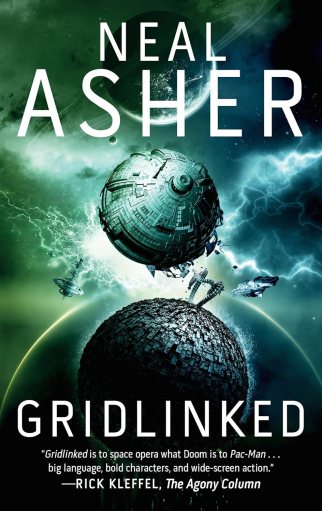
I read the first book in that series, Gridlinked, some years ago, but not being really enamored of it, hadn’t gone any further. The story of that book had a much stronger noir like feel to it than Asher’s later stuff. It spent a lot of time in the head of a villain I didn’t find interesting. That and his early prose felt particularly slow paced to me. I had a similar experience with another of his early books, The Skinner, which I never finished, and decided that early Asher just wasn’t for me.
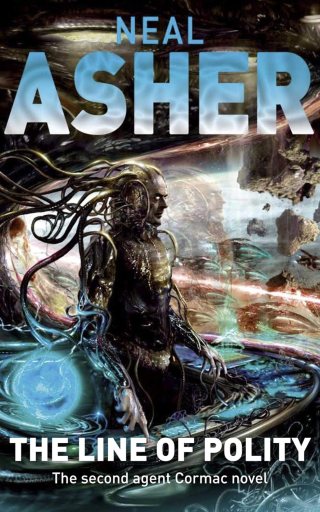
However, after finishing Dark Diamond, I wanted to learn more about the backstory of the characters, and so started reading the second book: The Line of the Polity. It turned out to be better than the first book, with a much more epic scope and interesting villain, a scientist named Skellor who infects himself with Jain technology and uses the resulting power to first take over a Polity battleship, and then attack a planet with it.
Jain tech in these stories is an ancient technology left from an extinct alien race. Using it seems to provide incredible power and benefits. But it’s a trap, one entire civilizations have fallen victim to. It ends up functioning as a virus, able to spread in both technological and biological systems. In addition to the villain, a couple of characters end up using the tech to recover from injuries, only to find their life and identity threatened when it begins to try to spread through them.
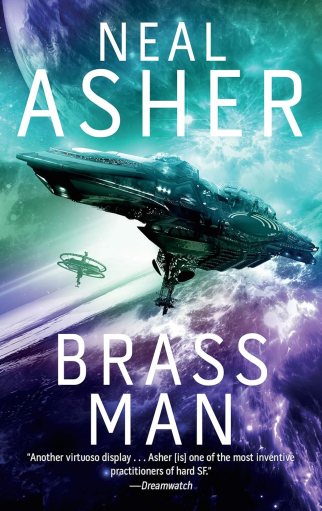
Skellor remains the primary villain in the third book, Brass Man. The title refers to a golem (android) named Mr. Crane, a particularly dangerous and insane character from the first book. Mr. Crane goes on a transformative journey, eventually becoming more sympathetic by the end of that novel.
He’s helped in his transformation by Dragon, a gigantic alien AI that features heavily in this series. Dragon is an entity sent by another alien race, The Makers, a civilization in the Small Magellanic Cloud, for purposes that aren’t clear at first. Dragon itself has become separated into four separate beings which travel through space, with each playing various roles as the series progresses.
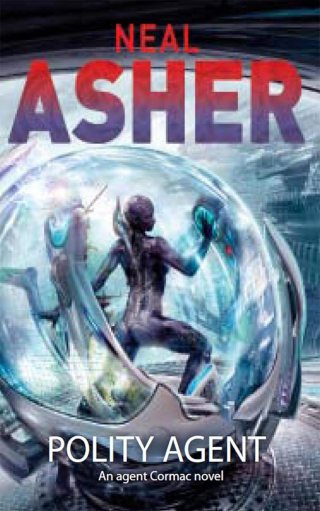
In the fourth and fifth book, Polity Agent and Line War, the scope increases as the villain switches to Erebus, a rogue AI that has melded with Jain tech, and wants everyone else to meld with itself. In the final book, this threat turns existential for the Polity. It finishes with a demonstration that while the AIs portrayed in these books are superbeings, as extensions of humanity, they have many of humanity’s faults.
As in all his books, Asher’s exploration of ideas is like mind candy. This isn’t hard sci-fi, so FTL, time travel, god-like AIs, and other magical technologies proliferate. This is classic space opera in the E. E. “Doc” Smith tradition. And his books always have a big payoff in terms of action. He’s very good at making you feel the pinch the characters are in, the desperate and often brutal decisions they have to make to survive. Or not. A lot of characters die throughout the series, or worse, are transformed into something monstrous.
But my recommendation for the series comes with a few major caveats. First, as I mentioned in the last review, Asher’s strength isn’t really in character development. Ian Cormac, the main protagonist, never really comes alive for me in these stories. Strangely enough, it’s his non-human characters, the various AIs, golems, drones, and transformed humans, who often seem the most vivid.
The second is what I mentioned above. The prose in these books is very heavy on description, which makes reading a slog, at least before the action heats up. I found it particularly bad in the fifth book, where at times I had to resort to skimming until the next batch of dialogue. Asher’s later books (from 2015 on) have more description than I care for, but don’t feel nearly as ponderous.
(I’m sure there are plenty of detail oriented people out there who love this type of prose, but for me it’s a lot of work. Apparently I’m not the only one, as this recent post from After Dinner Conversation indicates. It’s a stye of writing that for some reason seems prevalent among British space opera writers, which is frustrating because I love their stories.)
And finally this is a universe where characters can backup their minds, where machines can do everything humans can, and where human vulnerabilities are a frequent liability in battle. Yet a lot of the dramatic tension in these books is supposed to come from characters’ lives being threatened. It’s hard to feel too much sympathy for someone who’s in jeopardy because they’re too lazy to take backups.
Despite these complaints, the stories in these books do work at a visceral level and are a lot of fun. If posthuman space opera is your thing, they’re worth checking out.
There is one more book in Asher’s early stuff I’ll likely try, The Technician, mainly because it seems to be a bridge between this series and the one that starts with Dark Intelligence. But with other stuff in the queue, it may be awhile.
 SelfAwarePatterns
Good reminder for me this morning as I begun to work on my novel: don’t overdo objective descriptions. Make them multitask and at least reveal something about the character.
LikeLiked by 1 person
Kate Elliott, an SFF author in a recent interview, said that she wrote a YA series specifically because she knew the editors would be ferocious in pushing back against anything that messed up pacing, like telling her to boil a two page digression about some historical event down to a couple of sentences. It sounded like it had an effect on the books she wrote afterward. (I haven’t read her, so can’t judge.)
For you, I don’t recall it being an issue for A Footnote to Plato, and I’m pretty sensitive to it, particularly when it’s in audio. So your instincts are probably good already.
LikeLiked by 1 person
That’s good to know. Thanks!
LikeLiked by 1 person
Asher’s stuff didn’t really click for me, I think mainly because of the weak characterization. But I remember being really impressed by how thoroughly he communicates that the Jain are a threat. It’s like a Borg cube warping into an episode of Star Trek, or a Dalek rolling into an episode of Doctor Who. Every time Jain tech shows up, it’s such a great “Oh shit!” moment.
LikeLiked by 1 person
Asher’s definitely not for everyone. Do you read any of Peter Hamilton’s stuff? He actually outdoes Asher for detailed descriptions, to the extent I’ve never finished one of his books.
Yeah, the Jain are essentially The Thing but with a slower burn. I didn’t realize the Cormac series dealt with it so much. It’s a well he’s returned to many times.
LikeLiked by 1 person
I don’t think I’ve read Peter Hamilton. I’m looking over a list of books he authored, and nothing sounds familiar.
LikeLiked by 1 person