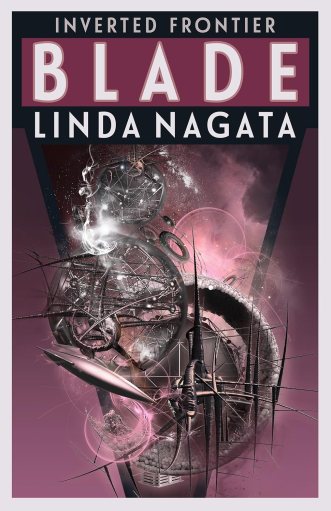
Blade is the penultimate book in Linda Nagata’s Inverted Frontier series.
I’ve written about this series many times. It’s a sequel to her earlier series: The Nanotech Succession. These books describe a civilization that has mastered nanotechnology, to the extent that mind uploading and new bodies on demand are possible, so everyone is essentially immortal. At least if they can survive in a dangerous universe.
It’s also a future where faster than light travel remains impossible. Yet, enabled by techno-immortality, human civilization spreads to the stars, with the core systems setting up vast Dyson sphere-like megastructures known as the “Hallowed Vastries.” And with other colonies further out.
But the colonies in the outer reaches come under attack by an alien menace, the Chenzeme, machine vessels apparently focused on destroying any intelligent life. Also across the centuries, those colonies watch from afar as the Hallowed Vastries disappear one by one. Word comes that they were destroyed by a mind virus which infected their populations.
At the beginning of this series, it’s not clear how much of humanity is left. A group of characters set out from an isolated and protected colony to explore the ruins of the Hallowed Vastries, the “inverse frontier” of the series title. The early books cover the team’s struggle with a god-life entity that nearly destroys them. The conflict leaves some of them with an advanced form of nanotechnology, which figures prominently in this fourth book.
This book also explores the idea of a civilization of intelligent machines, which brings up something I don’t recall being discussed except early in the first series, the general prohibition against full AIs. Throughout the books, the characters make heavy use of “DIs” (dull intelligences), intelligent agents without full human level intelligence. (In the book Memory, a sort of retconned book 1.5 for this series, they’re called “savants.”) But full intelligence is seen as dangerous and to be avoided.
However, the stories themselves call this principle into question. Nikko, a protagonist in the first series, is an artificial person, one whose existence is in danger in the first book due to the general prohibition against artificial people. Urban, the main protagonist of this series, constructs versions of himself for specialized work. And in the third book, a woman, known as the Cryptologist, is constructed to work on deciphering a difficult problem, an act seen as dangerous and unethical by most of the crew. In this book, the Cryptologist “frees” one of Urban’s specialized clones into an independent person.
So the prohibition against AI is not nearly as stringent as the taboo in the Dune universe, which doesn’t allow any computational systems at all. Overall the boundary is much blurrier. And the lack of faster than light travel in this universe, together with the general collapse of most societies (non of which are portrayed as collapsing due to AI in particular), makes the prohibition more an ancient caution than iron clad mandate.
As in the other books in the series, Nagata gives us a sense of the immensity involved in interstellar travel. Travel between star systems takes decades or centuries, with many characters electing to go into “sleep” storage for much of the duration. Characters living this long are not static, often evolving in ways that surprise themselves, in some cases horrifyingly so, another theme of this installment.
I enjoyed this book and recommend it. As I note every time I discuss one of her books, I think she’s an underappreciated talent, one who writes stories every bit as exotic and thought provoking as more famous writers. (It was actually a blog post from Alastair Reynolds, citing her as one of his inspirations, that initially clued me in to her work.) Her stories generally aren’t action packed extravaganzas, but more like haunting wonder dreams.
I’ve speculated before that a Polynesian worldview might be a strong influence on these stories, one of people scattered across vast distances, with uncertain communications and no central authority. In that sense, the Inverted Frontier series could be seen as a version of what might have happened if a group of 17th century Hawaiians decided to retrace the migrations of their ancestors across the Polynesian archipelagos, back to their ancestral homeland.
Nagata explains in a note at the end of this book that she plans one more in the series. And there are pretty good indications at that point what that final story will be about. I’m looking forward to it. (And hoping that the fifth book isn’t actually the last one.)
I should note that if you haven’t read any of the series, you don’t want to start with this book. It assumes too much from the earlier stories. At a minimum, you’ll want to start with Edges, the first in this series. Although if you want to be thorough, you’ll start with The Bohr Maker, the first book of the Nanotech Succession series. Two prominent protagonists in the Inverted Frontier series, Urban and Clementine, are also in the earlier one.
Have you read the book? If so, what did you think?
 SelfAwarePatterns
Got to thank you for putting me onto Linda. I’ve enjoyed all her books.
LikeLiked by 1 person
Thanks. Read anything else interesting lately?
LikeLike
Not really.
LikeLiked by 1 person
Star Trek also had god-like entities that nearly destroy them. Ah, where’s James Tiberius Kirk when you need him? Probably he’s off seducing the ladies. Does Trek: The Original Series have a ready room like The Next Generation does? That would be convenient for trysts. I’ll have to look it up.
Come visit my website, and leave some comments, if you like
http://www.dark.sport.blog
LikeLike
I read Edges a while ago, and I’ve been meaning to get back to this series. Good to know the series continues to be good.
LikeLiked by 1 person
If you enjoyed Edges, I definitely think you’ll enjoy the sequels. This latest entry wasn’t quite as epic as the others, but still pretty good. And it lays some pretty big promises for the fifth book, which is supposed to be out next year.
LikeLiked by 1 person
Really enjoy her books, thanks to your recommendation. I read an article she wrote somewhere saying she has hardly made a penny out of writing in 30 years. Hope she is now faring better.
LikeLiked by 1 person
One of the biggest eye openers for me when I started following authors is how little money there is in writing for the vast majority. Even most bestselling authors have to keep their day job. It highlights how much books really are labors of love.
In Nagata’s case, I think the biggest criticism I see of her work is that there isn’t enough action. I have felt that in one or two of her books, but usually don’t miss it. But it might be the biggest obstacle she’s faced for broader appeal.
LikeLiked by 1 person