Last week I watched Kingdom of the Planet of the Apes.
I’ve mentioned before that I’m a long term fan of the Planet of the Apes franchise. The reboot film series and its updated imagining of the overall premise have revived the franchise in an impressive manner. The new movies in many ways are very different from the originals, particularly in using CG technology to make the apes far less anthropocentric.
But they manage to capture the spirit of the originals in an important sense, one of putting up a mirror to humanity and exposing many of our deepest issues. It can at times feel a bit misanthropic, perhaps overly cynical about humanity, but it’s worth noting that the franchise often shows the apes in just as problematic a light. Often the real lessons seem to be more about our similarities than differences.
Which shouldn’t be too surprising, given that humans are just one branch on the hominid evolutionary tree.

One thing not particularly emphasized in the overall franchise is that there is just as much, or more, genetic distance between chimpanzees, gorillas, and orangutans, as between those species and humans. It is interesting that the chimpanzees are usually the ones more sympathetic with humans in these stories since they’re our closest cousins.
This new installment moves the rebooted franchise forward into the future, several generations after humanity’s fall and the apes’ ascendancy. (Promotional material says 300 years have passed, although I didn’t see that made explicit in the movie.) It moves us closer toward the original 1968 movie’s premise, a world ruled by apes, with humans as (mostly) beasts. Along those lines, it has some interesting visual callbacks, such as the creepy scarecrows, wild humans fleeing at the approach of ape hunting parties, and the music at times resonates with the original’s soundtrack. It even has the beginning of a forbidden zone, although it’s not called that yet, just an injunction against going into the next valley.
Caesar, the protagonist of the early films, is now a revered and legendary figure. Although not all apes know about his story. And his ideas have become appropriated and twisted by those with an agenda, again showing that the apes, once their intelligence is enhanced, are just a susceptible to many of the same temptations as humans.
As with the other movies, the story makes us squirm at times, particularly as what appear to be sympathetic figures have their own agenda. And there are times when it seems like the villain of the story has a point.
Anyway, I enjoyed and recommend it if post apocalyptic fiction with a twist is your cup of tea.
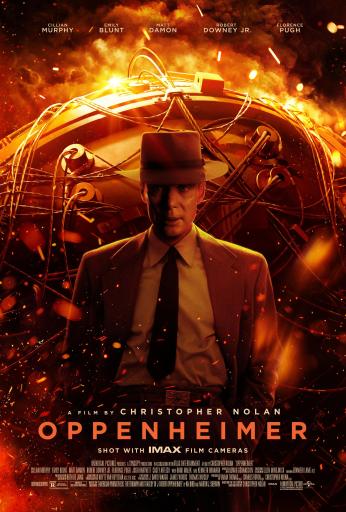
Oppenheimer got a lot of press and accolades when the movie was released. I finally sat down to watch it recently. While the story was interesting, the way the movie was put together didn’t work well for me. It’s very stylish and non-linear. The non-linear aspects in an of themselves didn’t bother me too much. I recognize what Christopher Nolan was doing, arranging things so essentially three different historical sequences climax close together. So we get the triumph of the war effort to build the first nuclear bomb superimposed with Oppenheimer’s post-war travails during the red-scare, in tandem with the subsequent blowback.
What worked less well was the effort to convert a mostly sedate story into a sort of thriller. I get that a lot of modern audiences want to always feel like they’re in an action movie or something, but it felt pretty forced in this case. It seemed to give the movie an unearned and artificially frantic feel. I had to take breaks to finish watching it. Maybe it was just my mood that day, but it felt like this was a story that could have taken its time a bit more.
I commented the other day on The Acolyte, the latest Star Wars show, which has been the target of review bombing. A lot of fans, in addition to political objections, are upset by how the Jedi are portrayed, and the changes to Star Wars canon. But I mostly enjoyed it. It’s much more interesting than a simple good versus evil story. In many ways, it feels more like the kinds of stories we see in anime, where the villains are just as interesting as the heroes. I do feel like some of the events in the final episode were a bit unearned, like they were necessary plot developments rather than organic character ones, but it won’t be enough to stop me from watching a second season, if we get one.
That’s some of what I’ve been watching lately. Have you seen any of them? Or watched anything else interesting?
 SelfAwarePatterns
Totally agree on Oppenheimer. We saw it at the theater and only stuck around for the actual detonation, then left. What a snoozer! Which is why I don’t really like going to the movies. So much better to watch at home where I can pause and fast forward.
LikeLiked by 1 person
I remember the second time I paused it thinking I was so glad I didn’t go see it in the theater, where I would have been trapped for three hours. I might well have bailed too.
One thing I did like during the pandemic was the concurrent release dates. It’s kind of a bummer that’s mostly gone now. But most of the time I don’t mind waiting for the streaming version. The theater experience is still better, but not better enough to make it worth it, at least unless friends want to go and make it a social event.
LikeLike
I thought Rise otPotA, with James Franco, presented a viable premise to the theme’s beginning. I’ve watched the others with mild enjoyment. I’d rank Rise alongside Heston’s TPotA.
How the hell we get from the West coast to the East, in order to present Lady Liberty downonherluck-stuckinthemuck remains to be revealed. Maybe this latest offering provides clues?
The Witcher blonde appears to have come into her own. Speaking of The Witcher… When does Liam make his debut?
LikeLiked by 1 person
Yeah, the original movies weren’t always coherent about geography. I don’t think these movies will ever try to sync up in that manner. But they are talking about a third trilogy after they finish this one, so who knows.
On the Witcher, I’m not sure when the next season is coming. Just googled and saw that it’s been renewed for a fifth and final season, so that’s good. The third season was okay, although I had become pretty tired of the romantic troubles. I think they’ve been to that well a little too much. Not that I won’t watch the fourth season as soon as it drops.
LikeLiked by 1 person
@curmudgeonaf @selfawarepatterns.com
My view isn't as bleak. Yes, humans can be selfish and short sighted, but if you watch documentaries on chimpanzees and other great apes, you'll see that they can be just as selfish, often going to war with other groups.
It is true that our intelligence allows us to do it on a bigger and more problematic scale.
LikeLike
Remote Reply
Original Comment URL
Your Profile
Why do I need to enter my profile?
This site is part of the ⁂ open social web, a network of interconnected social platforms (like Mastodon, Pixelfed, Friendica, and others). Unlike centralized social media, your account lives on a platform of your choice, and you can interact with people across different platforms.
By entering your profile, we can send you to your account where you can complete this action.
Mike, I respectfully disagree on Oppenheimer. It justly deserved its top awards. In short, the film’s creative approach to the reality of atomic weapons provided a look at what has become a tame and acceptable depravity over the years. I expected to see multiple depictions of an exploding atomic bomb and the devastation inflicted on tens of thousands of innocent civilians—what has become a hackneyed scene in film making about that subject. There was none of that. That was good in my opinion because we have become immune to such horror. Instead Christopher Nolan depicted the internal explosion to Oppenheimer’s moral sensibilities. For example, Oppenheimer’s victory speech after the first successful test was a visual depiction of the cognitive dissonance between Oppenheimer’s warlike victory speech and the moral conflict he was experiencing. Nolan also turned several ordinary scenes (political hearings) into surreal creations of light that mimicked the first few seconds of an atomic blast. It was a fresh and novel approach to the terrible horror of such weapons expressed within the context of our (often immoral) political battles. The evil of destroying one man’s career because of his politics was a counterpoint to the evil of killing tens of thousands of innocent people. I am grateful for Christopher Nolan’s art. I think you may have missed his point.
LikeLiked by 1 person
Hi Matti,
I think I picked up on what Nolan was doing there, but it just didn’t resonate emotionally with me as it obviously did for you, and many others.
To be honest, having read my share of WWII history, and despite the movie’s negative portrayal of them, I was more attuned to the military and political mindset of facing up to the grim necessities the world had forced on them. (At least during the war, not so much in the later red scare hysteria.) I don’t want to downplay the guilt he felt, but it’s a burden everyone in the war effort had to carry to one degree or another, one which was much more visceral for those directly involved in the fighting.
LikeLiked by 1 person
Mike, respectfully I appreciate you are, like so many of us, “…attuned to the military and political mindset of facing up to the grim necessities” of war. That is, I think, precisely what Nolan’s point was in this film. Perhaps some decisions (in war and politics) are not evil grim necessities forced upon us. Perhaps we have other less grim choices. I also appreciate that moral choices made in the fog of war are far from perfect. Finally, I appreciate the counter arguments that instantly killing between 125,000 to 225,000 innocent civilians—men, women and children—may be described as a war crime, in short, murder. The point is that Christopher Nolan was trying to retune what resonates emotionally and ethically with us. We are creatures of habit—including our moral inclinations. As I mentioned to you once before, moral action involves our feelings. That is, moral inclinations are formed by the cultivation of certain habits which, because of our nature, includes our emotions. So, I think Nolan was artistically trying to challenge our moral inclinations. We learned to accept some choices made in that war. Perhaps—as this film suggests—we should continue the moral debate. Challenging one’s mindset on moral issues is difficult. Nolan’s art definitely worked with me. You clearly were a tougher audience.
LikeLiked by 1 person
Matti,
As you note, decisions made in the fog of war are far from perfect, and easy to second guess generations later. And they didn’t know what we do today about nuclear weapons.
For them, it was between the people in those cities vs the estimated casualties involved in a land invasion (among soldiers just as innocent as the civilians), which we have to remember would also likely have involved widespread civilian casualties. https://en.wikipedia.org/w/index.php?title=Operation_Downfall&oldid=1235678773#Estimated_casualties
Of course, that’s a counter-factual, but one the leaders back then couldn’t ignore.
Some have said we could have compromised on the total surrender requirement, and left the existing militaristic regime in power. Or we could have blockaded the country indefinitely. But those would have required maintaining the nation’s war footing indefinitely, which wasn’t feasible.
Maybe we could have just done a demonstration, dropping the bomb in a unpopulated area. Maybe that would have convinced the leadership. However it’s worth noting that a portion of them tried to prevent the emperor from surrendering even after Nagasaki, which doesn’t make the demo scenario look like much of a missed opportunity.
All of which is to say, there weren’t easy answers.
LikeLiked by 1 person
Mike, I think some of what I’m trying to say is obfuscated by my feeble use of the language. I have already alluded to the fact that I appreciate the reasoning behind the decision made by Truman and his advisors in the summer of 1945. You obviously appreciate that reasoning as well by your last remarks. There’s no need to rehearse those arguments. To express my point in a different way I should say that any moral conclusion on an issue is corrigible—as are other philosophical and scientific conclusions. That is, such conclusions are subject to amendment and reform. However, choices once made tend to be justified and incorporated in a fixed moral and emotional mindset so to speak. Moral choice, even once made, is still a corrigible matter. As well as showing Oppenheimer’s internal struggle, the film artistically attempts to pry open our thinking and perhaps our closed minds on the matter. That is, in part, the purpose of art. I think Oppenheimer does so in a creatively masterful way. Many film critics agree. And, yes, decisions made in the fog of war are far from perfect, and “sometimes” easy to second guess generations later. But sometimes it’s not so easy—as in this case. But we should try to second guess them anyway. I am not suggesting that your conclusion on the matter is wrong. Not at all. That’s not my point nor I think Nolan’s artistic point in the film. I will, with respect however, disagree with you on one small point. Soldiers—at least by a long ethical tradition and by multiple international agreements—are not “just as innocent as the civilians.” As combatants they are in a different category from non-combatants. Perhaps I should have used those words instead.
LikeLiked by 1 person
Mike,Commenting the Kingdom of the Planet of the Apes you write « apes, once their intelligence is enhanced, are just as susceptible to many of the same temptations as humans ». Don’t you think that this « intelligence enhancement » is about accessing the performance of self-consciousness (of human self-awareness) ? Human temptation needs an awareness of oneself, a consciousness of oneself (should I do or not?). That performance differentiates us from our chimps cousins. It has been built up during the last 7 millions of years of our primate evolution (the pan-homo split.) Why such an event leading to so different lineages, in so short a time? A starting point could be the development of primate intersubjectivity carried by our last common ancestor (https://philpapers.org/archive/MENEOS-5.pdf). That could offer a rationale for the pan-homo split and bring some of our human specificities to find a place, like a neglected « evolutionary anxiety » that unconsciously guides our thoughts and actions (anxiety limitation generating many « temptations »). And also a possible rationale for human evil. I feel that the pan-homo split has still a lot to tell us on our human nature. Perhaps you have some ideas on that subject? ls let us know.
LikeLiked by 1 person
Hi Christophe,
I actually was a little nervous about that “intelligence is enhanced” line, because I feared it might be misinterpreted. The reality is more complex. If you watch any of the nature documentaries on chimpanzees, ones that follow the developments in a troop, you’ll see that a lot of human type emotions and social moves are present. They’re relatively simple compared to ours, but still there.
What the higher intelligence enables is doing it on a more massive scale, and with more sophistication. So a chimpanzee troop still has rivalries, betrayals, alliances, etc. They even go to war with other troops. They just aren’t intelligent enough to scale it to the level of wanting to conquer the world, or desiring to wipe our large swathes of their population due to abstract cultural distinctions.
LikeLike
Yes Mike,
Agreed , a lot of our emotions and behaviors are present in chimps lives. And it may be tempting to think of a difference of degree . A continuity from them to us.
But some problems appear in the continuity: Perversity, time travel, sense of the self,… Two possibilities then: consider these problems as « complex continuities» to be explained, or look for an evolutionary path not explored so far. I choose the second option using the evolution of identifications with others which leads to the build up of self-consciousness interwinded with an evolutionary anxiety, (the figure in the poster sent yesterday summarizes that). Human evolution is not finished for me, and a better understanding of the pan homo split process can highlight parameters for improvements.
But I may be wrong …
LikeLike
For me, the main discontinuity is symbolic thought, including language. It enables us to contemplate things on a much vaster scale, both spatially and temporally. So the autobiographical self we have ends up being much larger. I don’t doubt that chimps have one too, but it’s much more limited. The lack of symbolic thought makes it much hazier, far less structured, and so harder to be aware of their life narrative.
And of course, language enables sharing of mental states, enabling a much more developed theory of mind, and a far stronger degree of cultural learning.
But I could be wrong myself. In particular, every time we think we’ve found something that distinguishes humans from other species, someone finds something to cloud that distinction. So we’ll see…
LikeLike
Agreed about discontinuities of man vs chimps. If we now ask the question of chimps vs humans: why (almost) no evolution for them since last common ancestors? Chimps are capable of intersubjectivity and of some level of identification with conspecifics. Now, identifications with endangered or suffering or dying conspecifics is source of mental sufferings, of anxiety. And strong identifications => strong anxiety, potentially unbearable. Chimps lineage may have felt the mental sufferings as unbearable and stopped the development of identifications that fed our human lineage. On our side, charities, genocides, robots on Mars may be part of much needed anxiety limitation tools. So I feel that a better understanding of our modes of anxiety management could open a door on a possible improvement of human nature.
But I may be dreaming.
LikeLiked by 1 person