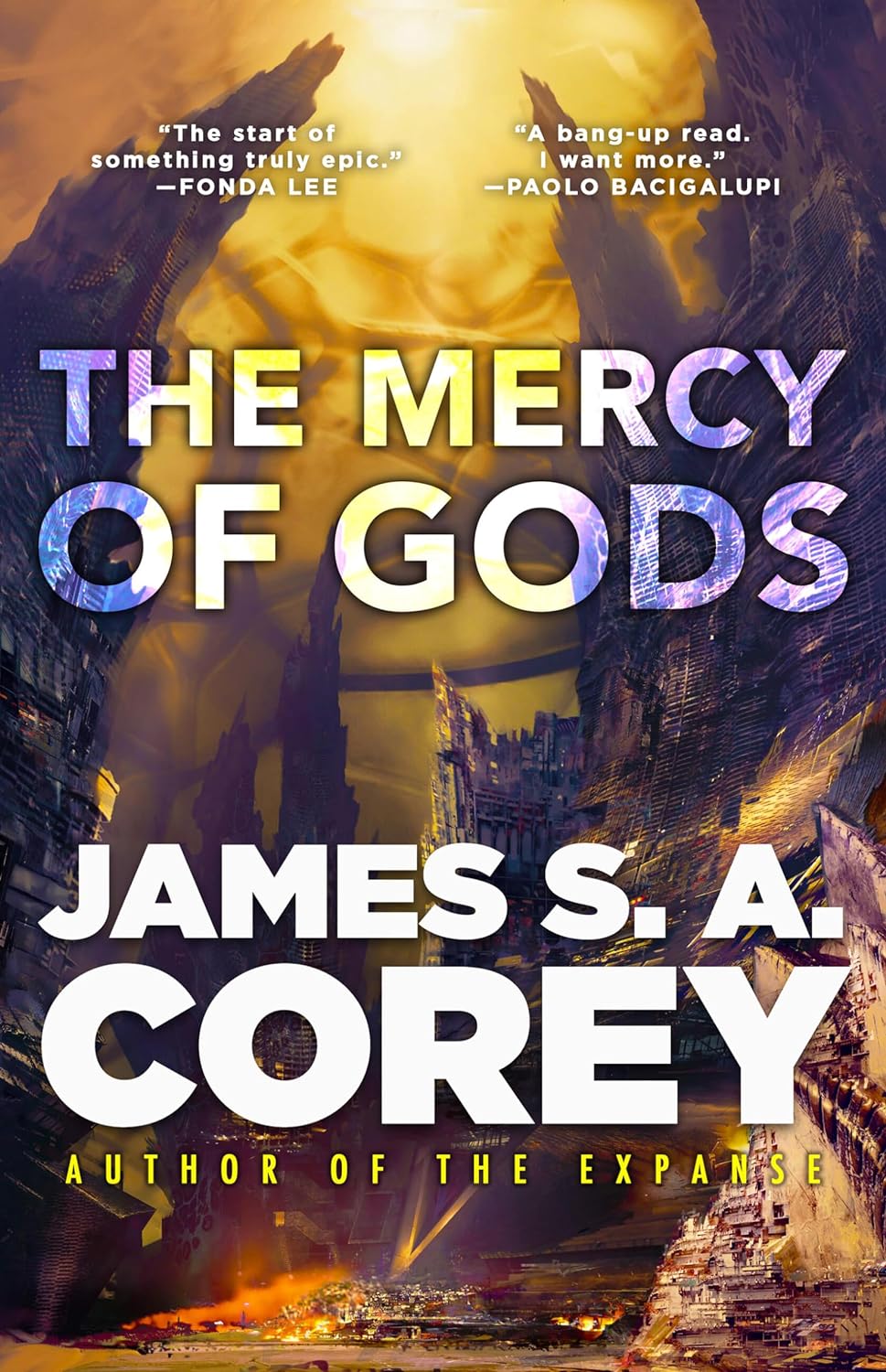
The Mercy of Gods is the first book in James S. A. Corey’s new space opera series: The Captive’s War.
James S. A. Corey is the pen name for the writing duo Daniel Abraham and Ty Franck, the authors of The Expanse book series. This new series appears to be either in a brand new universe, or in a period far in the future of the Expanse setting.
The story starts on a planet called Anjiin. Humans apparently arrived there long ago, with the details now lost to history. But the inhabitants know they’re not originally from Anjiin, because there are two biospheres present, one that seems to have natively evolved on the planet, and another, theirs, that seems to have been introduced relatively recently. The two biospheres aren’t compatible, and so basically ignore each other.
Most of the viewpoint characters are on a renowned scientific team that has discovered a way to have the two biosphere interact. They are trying to figure out how to deal with a political situation in the scientific institute they work in when the aliens arrive.
The Carryx have a vast interstellar empire. When they conquer a species, they generally add them to their inventory of subservient races, at least if they find them useful. Non-useful species are eradicated. When they arrive, it is with a couple of subservient species to handle any fighting and other logistical details. They announce that they will kill one eighth of the population of Anjiiin, and somehow do so instantly, just to demonstrate that resistance is futile, and proceed to subdue the planet in short order.
The Carryx capture many of the scientific elite and transport them back to their home world, including the team of biologists. After a harrowing journey, they are informed that usefulness to the Carryx is survival. They are tasked with trying to make an organism from one planet edible for an animal from another. But the situation turns out to be far more dangerous than they realize, when they learn that they have competitors assigned the same task, with the implication that losing could be deadly.
Unbeknownst to the team, they are also being watched by a spy, an engineered swarm entity of some type that can take over the body of a human, merging with and controlling them. Whoever or whatever the spy is, it isn’t friendly to the Carryx, and infiltrates the team as a vehicle to getting on the Carryx home world. It turns out the Carryx are at war, and the spy is an agent of their enemy.
Unlike in The Expanse, this initial book isn’t a story with a lot of space travel logistics or battles. One chapter does have a battle, but it’s told from the viewpoint of one of the Carryx. Instead, this is a story with a couple of themes running through it.
One is a review of just how strange extraterrestrial intelligences would likely be. The captured humans find themselves working in a vast complex with a multitude of alien species, all striving to complete tasks assigned by the Carryx. The Carryx and their enforcers use translation devices to speak with humans and other aliens. But no one else appears to have the devices, so initially the humans are unable to communicate with any of the other species. At one point in the story they do gain the ability to communicate with several of them, and they are all strange by human standards.
There are also hints later in the book that even the humans of this period may be strange in ways they themselves don’t yet understand.
The other theme is one of people surviving and functioning in a situation where they have been uprooted from their previous lives, transported to a strange environment, trying to do what is asked of them, and discovering that things are far more dangerous than they realized. It’s an exploration of humans having to cope in powerless and fraught circumstances. Some react by choosing to fight, even if doing so is hopeless and likely to have catastrophic results.
Most of the characters are intimidated and repulsed by the alien landscape in front of them, and so minimize their exposure. But the main viewpoint character, Dafyd, a junior member of the scientific team, has a personal history of acclimatizing himself to things that scare him, and so is able to gradually adjust to the situation, until he is able to approach their captors and begin communicating. In the process, he realizes that the humans are being tested on a broader scale than merely completing the assigned task.
So there’s a lot going on in this book. There is action in the story, but it’s more of a psychological thriller than anything. I enjoyed and recommend it.
I do have one beef, which is my standard one for a lot of contemporary fiction. I found the pacing a bit slow. It felt like the authors took 400 pages to tell a story that could have been told in maybe 300. Pacing was always a little bit slower in the Expense books than I cared for, but never enough to mention. Here it seemed more pronounced. To be sure, it wasn’t enough to stop reading, but I think I would have enjoyed it more with tighter prose.
That said, the writing is generally excellent, so if it sounds like your kind of tale, definitely worth checking out.


Yeah, this retired person had this one marked already but will wait until the price comes down. As an author myself I will never denigrate the price an author thinks their work is worth, of course sometimes it is the publisher and not the author who sets the price point.
And you are oh, so right about the pacing. No one can just write a novel in this genre anymore. It has to be part of a trilogy. And when the trilogy is on the way, the editors are making that stretching signal, like stretching taffy, that TV producers used to make to control live shows. Trilogies are stretched to a four book series, but a five book series is even better. How many books are there in the Expanse series, seven?”
Having said that I am gobbling up series from Michelle Sagara and C.J. Cherryh which are into their twentieth volumes, but even after a while, one’s favorite authors begin to pale.
One my all time favorite authors is Jack Vance, who in 300 pages would tell two complete tales, killing off half the fascinating characters he created in the process. He really took “kill your darlings” to heart.
LikeLiked by 1 person
I don’t blame you on waiting. I pre-ordered mine months ago. I don’t remember what the price was back then, but $15 for the ebook does seem a bit presumptive. I’ve been holding off on Neal Asher’s new stuff for the same reason. If his books sell at $21 for the ebook edition, good for him and the publisher, but I don’t need to read them that badly, particularly since I was disappointed in the one I did pay it for.
The Expanse had nine books, but I didn’t feel like they were bloated to get there. I thought all but one of the books were well done and delivered solid stories. Now that I think of it, the one I didn’t care for wasn’t exactly a fast paced one either. It had a lot of interior monologue, something this new book also indulges in. I’m okay with a reasonable amount of interior monologue, but it can definitely be overdone.
Never heard of Sagara. Looks like she’s primarily fantasy. Someone to remember next time I’m on a fantasy bent.
Yeah, Jack Vance was far from perfect, but boy did he know how to move a story forward. Honestly, I think most authors did prior to the shift to word processing, where a text could be revised and enhanced repeatedly without having to retype the whole thing. There’s something to be said for forced word economy.
LikeLike
I’m reading an alien story, Calculating God, but generally I’m not keen on them unless they’re humorous or compelling in some other way. Just no big on straight up alien stories. That said, I don’t mind watching movies or shows with them so long as it’s not too stupid. I don’t know if I already told you this, but we did finally watch Arrival, by the way, and I enjoyed it. I thought the logograms were a nice touch.
LikeLiked by 1 person
I’ve never been able to get into Sawyer’s books. Not sure why, but his writing never quite clicked for me.
Yeah, I think humor makes just about any story tolerable for someone not into its genre. Can’t say there’s much of it in this book. The Corey team is pretty good at making you care for characters, but it’s a pretty serious tale.
It’s been a while since I watched Arrival, so not recalling the logograms. I just remember the plot twist at the end being pretty cool.
LikeLike
One thing I was wondering was whether this was a continuation of The Expanse or something totally separate. I still haven’t finished The Expanse, so if this was a continuation I’d feel compelled to wait. If it’s not, I can jump in sooner.
LikeLiked by 1 person
It’s completely separate from The Expanse. If it is in the same universe, it’s so far removed from the events of that series, that you should be totally fine to jump in. The only drawback is having to wait for the next book, although they’ve historically been pretty reliable about getting books out in a reasonable time frame.
LikeLiked by 1 person
I’ve been reading The Expanse so slowly. Waiting for the next book probably won’t be a problem for me.
LikeLiked by 1 person
If you’re not getting sucked into them, they may not be your thing. I’m like that with some other authors. Their books might seem exactly what I should love, but the reality doesn’t always click.
LikeLiked by 1 person
Oh no, I’m enjoying them. But they are long books, and I read slowly. Also, when I’m reading a series, I like to read other things between each book. So it’s just taking me a long time.
LikeLiked by 1 person