What would aliens look like? Not just another intelligent species, but alien animals, or entire ecosystems? It’s very hard for us to imagine them without falling back on variations of Earth animals. So aliens in sci-fi often look like insects, octopuses, or other species we’re familiar with.
To be sure, aliens would have evolved in the same universe we’re in, with the same laws of physics. So it seems reasonable to expect some convergence, much as we see with evolution on Earth. A fish shape, for instance, turns out to be ideal for moving quickly in a liquid environment. Which is why mammals that move back into the sea, such as whales and dolphins, eventually evolve back into that fish-like shape. And camera-like eyes reportedly evolved independently at least thirty times.
On the other hand, the diversity of solutions evolution comes up with on our planet is striking. And we should expect differences in the environment on other planets to cause subtle, and not so subtle changes in evolutionary pressures. And that a large part of the environment is provided by life itself (oxygen, soil, trees, etc.). So even on a planet relatively similar to Earth, we might see radically different biospheres.
These alternate ecosystems are very hard to imagine. Sci-fi sometimes gets there, but it seems relatively rare. Alien Clay is Adrian Tchaikovsky’s shot at an attempt. He describes a world where life works very differently.
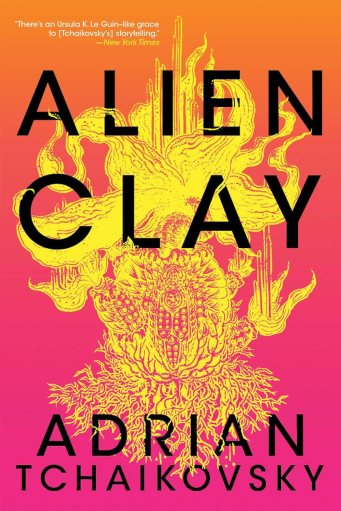
Arton Daghdev is a biologist who bristles under the ideologies of the Mandate, the authoritarian regime that runs human society. This leads him to join the revolution against that regime, which eventually results in his arrest and exile to one of the labor camps the regime maintains on exoplanets. Since there is no FTL in this universe, with interstellar travel taking decades in some kind of suspended animation, the sentence essentially removes political prisoners from Mandate society.
When Daghdev arrives on Kiln, the world he’s been sentenced to, he discovers a vibrant and seemingly aggressive alien ecosystem, with the human labor camp in an isolated dome, and a constant risk of alien infection of some type, which apparently alters people and drives them mad.
It turns out that the Mandate is keeping a secret here. Ancient ruins have been found, with writing that a team of archaeologists are attempting to decipher. But there are no signs of an intelligent civilization level species, at least none that the team of biologists studying the life on Kiln have been able to find.
As a distinguished biologist, Daghdev is interviewed by the camp commandant, who is very interested in solving the puzzle of the ruin builders. He is assigned to Dig Support, the team that assists the scientists. The scientists have to walk a tightrope. They must show progress in frequent presentations to the commandant, but must carefully present their results in a way that doesn’t violate Mandate ideology, which expects them to find something human-like behind the ruins. However, it quickly becomes evident to Daghdev that Kiln operates by its own rules, which don’t fit human preconceptions.
At the same time, Daghdev ends up joining the local revolution in the camp, with a goal of overthrowing the commandant and his security team, and gaining access to the ship in orbit around the planet in order to return to human civilization, dystopian as it is. We get a picture of a society back on Earth that has had a revolutionary undercurrent for a long time, with entire generations growing up under the secret committees and sub-committees of the revolution. Most of the characters have eastern European names, evoking imagery of the long history of struggles against authoritarianism in that region.
So it’s not a happy tale, at least not at the beginning. Without getting into spoilers, things become increasingly dire, until we get a perspective shift toward the end, one that redefines the relationship between the humans and the alien biosphere.
I enjoyed this book, primarily due to the ideas about biology that Tchaikovsky explores. But as usual I have to caveat this by noting that his writing often remains a struggle for me, although obviously not an insurmountable one. In this case, he has long stretches with no dialogue, either because Daghdev is ruminating on the biology or political situation, or because Tchaikovsky is telling us about conversations rather than showing them. It made the story feel slow, and many of the characters distant.
But as with his other books, it wasn’t enough to stop me from reading. And of course many will find his writing the best part. So if exploring the idea of a completely different way for intelligence to work in an alien ecology sounds appealing, with some revolutionary dynamics thrown, then I recommend checking this one out.
Have you read it? If so, what did you think? Reading anything else interesting lately?
 SelfAwarePatterns
For books like that, drop the whole thing into an LLM AI and ask for a Cliff notes version.
Astrobiology: I always thought that was a joke as a serious science. We have one example of biology, Earth’s. So, astrobiology is really just biology. Any application of “astro” is pure science fiction, which is where it belongs.
There are so many good explorations of possible biologies in sci-fi: Scott Card, Foster, Gillis, Scalzi and many others. I’ll have to add Tchaikovsky.
I get that Earth’s biology can inform sci-fi biology, and must, really. Early “bug” xenospecies in novels neglect the whole O2 saturation level that appear to limit insect size. Sure, there could be other oxidation/energy generation mechanisms, but for the most part, bugs in space just don’t realistically work.
One of the quizzical topics of alien species is the need for genetic cross pollination. Sex. That’s a whole other weird narrative theme.
Speaking of which, Ice Planet Barbarians, pulled that into Libby (audiobook reader) and, ooh boy, what a raunchy ride that was. Kept me engaged, even through the 2nd in the series. Sci-fi romance, it’s called. A first time for me, no longer a virgin, I guess.
LikeLiked by 1 person
Pasting into an LLM would be too much work. Besides I haven’t found AI summaries that reliable. And in this case there’s the Wikipedia synopsis. But my griping about the writing aside, the story is good enough not to do it. I do sometimes pre-read a synopsis before reading the book, but it’s so I can focus on studying how the author makes it work.
There is some interesting work that happens in astrobiology, but right now it’s mostly missing that reality check most of science depends on. The main thing to remember is all they can currently do is explore possibility space, not authoritatively settle any disputes.
I’ve read Card, Foster, and Scalzi. (Not sure who Gillis is.) They have cool ideas, but their aliens don’t really break out of the Earth centered paradigm. That’s not a criticism, since it’s extremely hard to do. And to the point about astrobiology, we can’t even be sure it’s necessary.
Good points about bugs. They could still be used if we remember the kind of environment they’d have to come from and live in, but giant aliens attacking people on present-day Earth with its oxygen and pressure levels is fantasy.
I’ve never gotten into book erotica. No issue with it, but my preferences run more visual.
LikeLiked by 1 person
The AI quip was quasi-spoof. And the erotica? A dart throw that paid off. Had to sample due to the title, didn’t realize what “mature content” actually meant.
I’d like to see an author like Dr. Lewis Dartnell write sci-fi. Maybe he’d get alien biology closer than most.
LikeLiked by 1 person
Interesting title. From your description it sounds a lot like Solaris, which had as its alien an ocean that was impossible to communicate with, or rather to know you were communicating with.
LikeLiked by 1 person
I had more in that comment but it all went poof. That’s what I get for doing anything on my phone!
LikeLiked by 1 person
Ugh. Sorry. I guess all these commenting environments leave a lot to be desired.
The Solaris example is in the right neighborhood. But Tchaikovsky is more explicit and leaves you with a firmer understanding of what’s happening. (At least based on what I’ve heard about Solaris; I’ve never read it.) The biology he presents is very alien, but it doesn’t cross into complete mysticism. Although some of the characters, when it’s explained to them, react as though it did.
LikeLike
I’m surprised you haven’t read Solaris. I thought for sure you’d have read it. Yeah, in Solaris, the ocean entity is something of a head trip. I’m not sure it crosses into mysticism, but it has been a while since I’ve read it.
LikeLike
Too many books, not enough time. I did once try to watch the old movie, but couldn’t finish it. I only learned about the book years later. I said “mysticism” because I’ve heard that at the end the conclusion is the alien intelligence is beyond human comprehension.
It reminds me of 2001 A Space Odyssey. The Kubrick movie is inscrutable, by design. But Clarke’s book provides an explanation of what’s happening. I recognize Kubrick’s version for its technical achievement and attention to detail, but if I hadn’t read the book, I’m pretty sure the movie wouldn’t have worked for me.
LikeLike
I enjoyed reading his “Children of …” set, mostly for his takes on other forms of consciousness/intelligence, so I guess I’m going to have to read this one. Hopefully it won’t be too close to “world intelligence” in that other set.
*
LikeLiked by 1 person
I can confirm this book has a different concept. It’s hard to say much more without spoilers. I think you’d enjoy it, but it is a very different type of book from the Children ones.
LikeLike