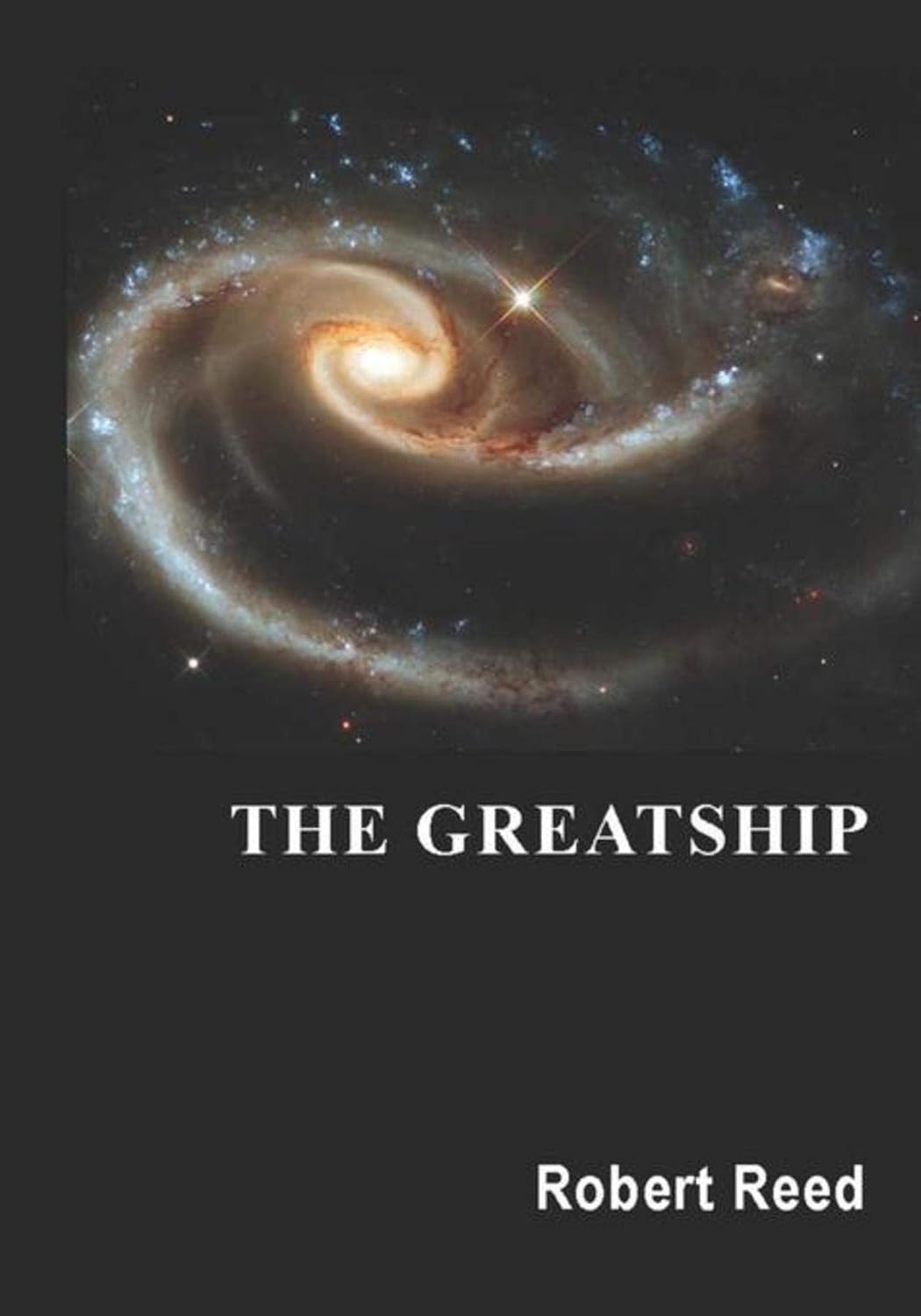
In the last post I said I’d get back to Robert Reed’s Greatship series. This week I read the main story collection for that series: The Greatship. This is a collection of novellas and novelettes, which seems to be the format Reed really shines in. These are all separate stories, but they take place in a shared setting, with repeat and crossover characters. The result, even though it’s not one unified story, feels somewhat like a long novel with several threads, each told from a particular viewpoint.
The central concept is the alien megastructure named in the title. It’s a spherical object about the size of Uranus with gigantic rocket engines on one side. It’s discovered outside the galaxy, but moving at a third the speed of light. And it appears to be billions of years old, long abandoned by whoever or whatever built it. It’s filled with innumerable tunnels and caverns, some of which are so enormous that entire ecological environments can exist within them.
Humans discover and reach the Greatship first, giving them salvage rights under the ancient laws of the galaxy. In this universe humanity is a young and relatively minor species. But this acquisition makes them a major player on the galactic stage. They convert the Greatship into a cruise ship, which they intend to take on a three hundred thousand year tour of the Milky Way. They allow large numbers of humans and aliens to buy passage, which can be purchased through various means, including trading colonization rights on various planets, new technologies, or any kind of novel knowledge.
This arrangement results in a large number of alien enclaves in the Greatship, which end up feeling like proxies for their home world environments and cultures. The Greatship becomes like a large metropolis that has neighborhoods for all the major ethnicities in the world, but in this case it’s alien cultures and environments.
Similar to Reed’s Sister Alice universe, there is no faster than light travel. But all advanced species are immortal, including humans, who have achieved it through genetic engineering. Most of the characters are tens of thousands of years old. Which makes taking millenia to reach a destination more an inconvenience than an obstacle. However, interstellar travel is still a dangerous and uncertain endeavor. And the idea of a galaxy wide empire seems infeasible, although we learn in one story that a shadow one already exists.
While humans are immortal, there’s no discussion of uploading or backing up. (Reed does flirt with it in a couple of stories, but it’s limited.) A human is able to recover from any injury, no matter how devastating, as long as their brain is left intact. These “bioceramic” brains are described as tough and endurable, but not indestructible. So characters can and do get killed. The recovery ability is actually at times used by characters strategically, such as knowing ahead of time that their body will be destroyed under intense acceleration, or in a crash, but will still rapidly recover.
This is not the post-scarcity utopia seen from many other authors. Resource constraints remain a reality, along with the associated economics and politics. One aspect of this is that Reed actually has fuel consumption be a concern for his characters operating in space, at least acknowledging the staggering energy requirements necessary for interstellar travel, something that even ostensibly hard science fiction often ignores. The main aspiration of this vision of the future is that mortality is a solvable problem, making the universe within reach, resulting in a fertile ground for stories.
My favorite story in the collection actually takes place outside of the Greatship. In “Mere”, a group of pilgrims set out for the Greatship, but their ship suffers a catastrophic accident, killing everyone on board except for one embryo, which the ship AI nurses into a girl kept in sensory deprivation for millenia, and then, with life support systems failing, manages to drop her on an alien world. The natives note that she fell from the sky, observe her ability to recover and immortality, and worship her as a god. These aliens, due to the quantum processing in their brains, can glimpse other realities in the quantum multiverse, and so end up having a very different attitude toward existential dangers than their posthuman god.
But most of the stories do take place on the Greatship, exploring the different communities that exist there, human and alien. The Greatship is run by the captains, where “captain” seems to refer to all the commanding officers on the ship. A few of the stories are told from their point of view, although we don’t see the Master Captain in this particular collection.
There’s a lot to like in these stories. Reed explores a lot of interesting concepts. If you’re a hard sci-fi fan, I recommend checking them out.
But as usual, I have to note a few nits. One of them Reed himself admits in an intro to his latest novel, Hammerwing: the collection has a fair number of typos, which the Amazon entry flags as a quality issue. I noticed these but didn’t find them too distracting. A bigger issue for me is how often I didn’t know who was speaking in dialogue. At times Reed excessively over specifies the speaker, but often he assumes we can figure it out when it’s not obvious. (My preference is for writers to err on specifying too much, but that’s obviously a matter of judgment and style.)
And I do have one skeptical reaction I had trouble reconciling away. I mentioned the ability of humans in these stories to recover from any injury that leaves their heavily engineered brain intact. It makes for a lot of cool scenarios. But often the recoveries, such as regrowing limbs, are so rapid that the chemical kinetics and thermodynamics seem dubious, like it would involve chemical reactions so fast that flesh would end up getting cooked. Admittedly some story sequences would have a little less punch without these rapid recoveries.
In the end, none of these issues prevented me from enjoying the stories.
Have you read any of them? If so, what did you think? Any recommendations on similar works?
 SelfAwarePatterns
What I most crave from sci-fi is the exploration of different and “higher” forms of consciousness. Bank’s Excession being a good example. Having on the whole found myself both disappointed by and despairing of life as we currently know it, I am always fascinated by people’s thoughts on how it might be improved in the future.
Disappointingly even some of Bank’s Minds give way to despair and despatch themselves into oblivion, which I find a bit of a non sequitur. If you are that advanced, everything should be at your finger tips. So I suppose I have never worried as the the hardness or otherwise of the science which can, in any event, only be judged through the lens of our current and probably highly limited knowledge base.
Hence the type of sci-fi I find most tedious is where the characters have no mental advances on where we find ourselves today. Where bog standard f***”d up humanity and alien life roam the universe in the same old thug like fashion we have seen on earth for thousands of years.
I’m looking for progress in sci -fi, not an expansion of the awfulness of life on earth to a tired universe.
That does of course tie in with my desire to see better in general: better behaviour, better hedonic setpoints, far greater horizons in philosophy and “purpose”. As well of course as in science: and in particular in the expansion and improvement of consciousness and intellect.
So I suspect The Great Ship might not take me where I want to go.
LikeLiked by 1 person
Reed may well not be your cup of tea. I do think he presents the human condition as improved compared to what we have today. If it wasn’t, immortality would be a pretty bleak proposition.
But he also still has money, class, and ambition in these stories, along with all the evils they bring in. And he doesn’t do the Banks move of comparing the advanced society with regressive ones. His interest often seems to be more in exploring how psychology is affected by biology (as in alien biology) and circumstances.
Although not all of the old ills are retained. Sexual dimorphism, as in different heights, physical strength, etc, seems to have been engineered away. And there are no signs of anything like racism. There is some discrimination, but it seems to be on traits that people can choose to have or not. (Basically every aspect of their physicality is optional.)
I do think his fiction would be strengthened if he did more to explore how all of this and living tens of thousands of years affects people’s psychology. There’s actually little to none of that in these stories, which feels like an omission.
On science hardness, I fully realize that’s a matter of taste. While I enjoy Banks’ fiction, speculation about how things can be better constrained by the science we know feels more substantive to me, something I can believe in easier. It’s why The Algebraist is currently my favorite Banks book, mostly due to its more grounded take. Along the same lines, when the AI at the end of Look to Windward reveals it plans to commit suicide due to its guilt about its role in the war, it was the bitter element that made it feel more real to me. Maybe I just need the bitter there to contrast with the sweet.
And there’s overall the fact that stories, to hold our attention (at least for most of us), need to have some conflict, some gradient of feeling. It’s why so much sci-fi is set in dystopias. They’re much richer ground for conflict. And why even Banks has to mix in dystopias with his utopia to make his stories compelling.
LikeLiked by 1 person
This does sound interesting to me. Sister Alice as well. Thanks for the recommendations. The Greatship itself reminds me of a French comic book series called Valerian. Many of the stories are set on a giant space station that’s sort of an ad hoc assemblage of smaller space stations built by many different species.
LikeLiked by 1 person
I only read a little of Valerian when the movie came out years ago, so can’t say much on the comparison. It is interesting that the characters who recur most often in The Greatship are a married couple: a rich woman named Quee Lee and her young adventurous husband Perri.
LikeLiked by 1 person
That’s kind of neat, too. I like seeing married couples in Sci-Fi. Specifically married couples in protagonist roles, or protagonist-adjacent roles. I feel like it’s a bit of a rarity on science fiction.
LikeLiked by 1 person