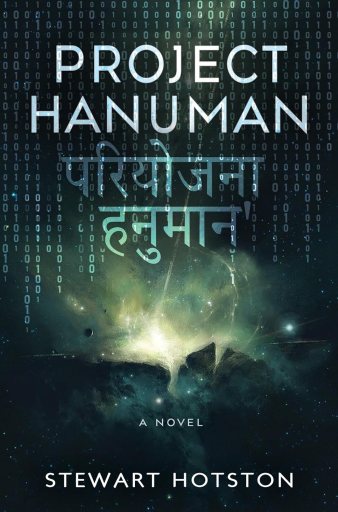
Stewart Hotston acknowledges that his Project Hanuman is inspired by Iain Banks’ Culture novels. The society he describes, known as the Archology, is very similar to the Culture in many respects. However, where Banks’ books usually have the Culture as the dominant civilization technologically, and always have them coming out on top, Hotston’s Archology finds itself in a desperate fight, with its survival hanging by a thread.
Like the Culture, the Archology is pretty much run by vast minds, referred to in the story as nodes. And it appears to be the most advanced civilization in the galaxy. And similar to the Culture, it likes to meddle in other less advanced civilizations.
The Archology has a scheme for classifying civilizations. Type one, most civilizations, is restricted to their planet of origin. Type two understand materials on a deep enough level to construct them out of something other than quarks. Type three has learned how to use the type two insights to travel faster than light. Type four civilizations have learned that information is the fundamental substrate of reality, with the physical only an aspect of that reality; learning to manipulate things at the information level gives them vast powers to alter things at the physical level. At the beginning of the story, the Archology sees itself as the only type four civilization.
But there are some differences between the Archology and the Culture. The Archology mostly lives in information space, with its citizens existing in arbitrarily constructed play worlds. On the surface, this looks like they’ve just uploaded themselves into virtual realities, but as the story progresses, it becomes clear it’s much more profound, that they’re heavily extended into information space with only a foothold remaining in the physical.
The Archology also isn’t as anarchist as the Culture. The society has strictures it enforces. The result is that two of the three viewpoint characters in the book don’t fit in. Prab is an Excluded, someone who has chosen to live outside of the Archology, in the physical world in a printed body, mainly because she wants to live in her own mind without anyone intruding. And Kercher, for the crime of wanting to be able to die, is convicted and sentenced to be the pilot of a warship in the physical. The third viewpoint character is the warship itself.
At the beginning of the book, Prab is mulling her recent visit with family members who are constantly trying to convince her to return to the Archology, when suddenly the Archology seems to disappear. As an Interlocutor, an expert in communicating with entities outside of the Archology, she finds herself summoned to the ship piloted by Kercher. They then travel to a major Archology world and find it under attack, from an enemy who seems able to manipulate reality at the same scale as they can. And the Archology is losing.
Prab, Kercher, and the ship find themselves in possession of a backup of the Archology, looking for a new home for it to regrow. But they are being pursued by the enemy, an enemy whose goals and motivations they fundamentally do not understand.
The central idea of the book is that reality is primarily information, not information as something equivalent to the physical, but something that transcends it, something the physical is derived from. Many of the battles take place in an information space outside of physical reality. In one fight scene, Prab and the enemy, who calls itself the Face of Loss, fight by imagining things into existence. There is also some Indian mythological imagery mixed in. So it’s a strange book, but in a good way.
As I noted, this is inspired by Banks’ Culture setting, but Culture fans should know going in that it’s a bit of a deconstruction. Without getting into spoilers, the apparent technological superiority of the Arcology turns out to be something different than what it appears. And while the Archology has dialed up the utopian aspects into being able to live in whatever heaven you choose, it has some darker ones, such as not respecting the privacy of minds, or not allowing anyone to die if they choose.
It’s a fascinating book which I recommend if posthuman space opera is your kind of fiction.
 SelfAwarePatterns
When the price comes down … I will buy a copy. Thanks for the tip!
LikeLiked by 1 person
That’s the problem with having niche genre interests. Often only the newest stuff is interesting, and that means paying full price. Although the price for this one didn’t seem too bad, at least for the Kindle ed.
LikeLike
It is not really outside of my “window” of acceptable prices, but I go through periods in which I spend more or less, and right now I have spent more, so I am correcting (maybe overcorrecting) for a while.
LikeLiked by 1 person
Naughtily, illegally and immorally there is a darkweb site where you can download most of what you want for free and then convert it with Calibre to an ebook format of your choice. I haven’t used it, tempting though it is.
LikeLike
Presumably most LLMs will be stealing it already.
LikeLike
At £6.50 it’s not likely to come much cheaper surely? Or do these type of books drop like stones? Banks is still at very high levels.
LikeLike
Sounds absolutely fabulous. I’ll be ordering it.
LikeLiked by 2 people
Hope you enjoy it!
LikeLike
You might want to indicate early on that this is a book review, as opposed to some discussion of information and reality. 🙂
LikeLiked by 3 people
Hmmm. I would have thought the book cover and first paragraph made it obvious.
LikeLike
umm, I see no indication of a book cover, as opposed to some interesting matrix-style graphic. And I had to read the entire first paragraph before I figured it out.
Ah well. Carry on. 😊
LikeLike
Fair point on the cover. With my current WP theme, the image gets cropped in the header. Just made it more obvious (hopefully).
LikeLiked by 1 person
I picked it up fairly quickly. However…
“The central idea of the book is that reality is primarily information, not information as something equivalent to the physical, but something that transcends it, something the physical is derived from. Many of the battles take place in an information space outside of physical reality.”
If physical reality is derived from information, then aren’t we and the battles already in an information space? Is this additional space just a bit more “informationary” than our regular space?
LikeLiked by 1 person
That’s the implication. It’s stated that being able to manipulate information space gives you power to manipulate physical space on a pretty large scale, which is demonstrated in the various battles. But we’re never given a clear description of the rules.
It’s also eventually revealed that there have been debates within the Archology whether they should even maintain an anchor in physical space, with the vulnerabilities it entails, or just move completely into information space.
It’s not clear whether this is a version of Indian idealism, or maybe some kind of techno-platonism, as strange as that sounds.
LikeLiked by 1 person