In the last post I discussed my recent exploration of Reddit. The one conversation I’ve started so far was a request for posthuman space opera recommendations, particularly ones without FTL, stories that envision what the future might be like if we can’t get around the speed of light limit. One hidden gem recommended was Sean Williams’ Astropolis trilogy.
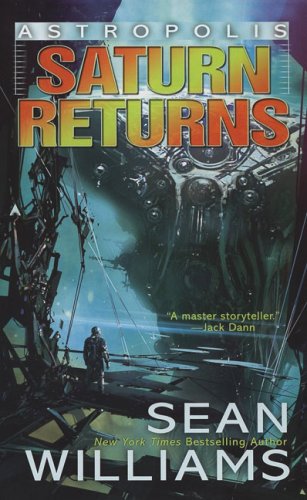
Williams imagines a far future where humanity, or at least its posthuman progeny, manage to settle the galaxy within 150,000 years. Traveling the galaxy takes centuries or millenia, but this isn’t too much of an issue because just about everyone is immortal. Characters in interstellar journeys also benefit from being able to control their tempo, the rate at which they experience time, so that a trip that takes centuries in “time absolute”, only takes a few days or weeks subjectively.
Although it’s established in the second book that, when possible, most travel takes place via hardcasting, where individuals are scanned, converted into information, transmitted, then centuries or millenia later reconstituted at the destination. It isn’t exactly teleporting, since the scanning and reconstitution can take consider time, with verification checks to make sure someone was rebuilt with fidelity.
The interstellar civilization is known as the Continuum, which exists over a galactic network known as the Line. In the Continuum, the closest thing to old-time humanity are the Primes. They have open ended lifespans, although it’s implied in the books that most do eventually die, either by accident, because only one instance of them exists, or by choice. Most of these set their tempo at time-absolute, the rate of time perceived by old-time humanity. The oldest Primes, ones whose lives stretch back to C20 (the twentieth century) are known as the Old Timers.
Singletons, like the Primes, are still recognizably human, but can exist as multiple copies, copies which can be distributed far and wide. The copies can meet up and synchronize memories, allowing Singletons of the same person to have a more or less unified personality. Although differences can creep in. But from moment to moment, each Singleton is an individual. Tempo is pretty flexible among Singletons, ranging from the same rate as Primes to very slow ones.
A gestalt is a group mind, a collection of bodies without much individuality in any particular body. Their relationship to tempo seems similar to the Singletons.
Forts are another type of group mind tied together with with Q-loops, connections which allow reliable independent communication between their Frags, the individual bodies that make up the Fort. The overall Fort minds have a tempo set very low, so that their perceptions span centuries. It leaves them disconnected from the rest of humanity. In earlier history, the Forts play a crucial role running the key infrastructure of the Continuum civilization.
Someone born into one of these types can decide to become another, although the process of becoming a Fort is arduous and risky, with many failing, even under peaceful conditions.
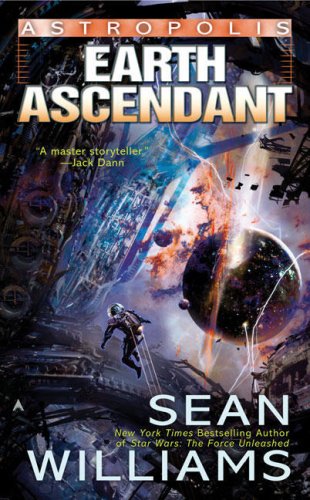
The first book begins in the 879th millennium. Imre Bergomasc awakens in the care of the Jinc, the local component of a gestalt (group mind) known as the Noh. The Jinc are looking for God at the edge of the galaxy. They come across a debris cloud, which they collect and are able to reassemble. It turns out to be a cylinder storing a mind, Imre’s mind. They are able to recreate his mind and instantiate him in a body.
However, there are pieces missing, and they are forced to fill in with assumptions. One of those assumptions is Imre’s sex. They guess female. When he first awakens and discovers himself in a female body, he immediately recognizes that it isn’t right, and later asks them to correct it. Although his ability to remember his past life is limited. Eventually he discovers that he’s in danger and is able to escape.
Imre was once the head of a military organization known as the Corps. As he returns to civilization he begins to find members of his old team. As each team member is found, they relay their story in of the last several hundred thousand years.
It turns out that the current version of Imre comes from a mind backed up before a lot of history. During that history, something initiated a Slow Wave that propagated out from somewhere near the center of the galaxy. The Slow Wave disabled the Q-loops connecting the Frags of the Forts together, destroying the overall Fort mind and turning their Frags into mindless entities. The Forts throughout the galaxy are wiped out. The galaxy enters a time of chaos. The Continuum is now fragmented into various societies.
Some of the societies attempt to rebuild by constructing new Forts. But a clandestine organization known as the Barons always attack and destroy any incipient Fort before they can do too much. And there appears to be another clandestine organization known as the Luminous, manifesting as silver balls, which also suppress the creation of the Forts, while also seeming to be an enemy of the Barons.
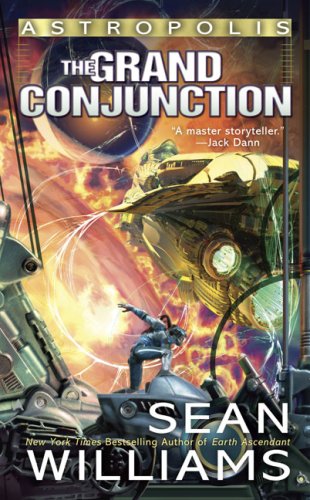
As the books progress, we get further into the future. By the beginning of the third, we’re over two million years out. And that story takes us further still. It turns out that Imre’s past self played some kind of pivotal role in the history leading to the current civilization. The books are about Imre rebuilding human civilization, then investigating his own past, learning what really led to the Slow Wave, and finding out who his real enemies are.
If you enjoy posthuman space opera in the style of Linda Nagata or Robert Reed, then these books are well worth checking out. The writing is excellent, although the worldbuilding in the first book can feel overwhelming at times. And there are times where it seems the only reason some of the characters do what they do is for the plot. But overall none of it was enough to stop me from reading and enjoying the story.
Lamentably these books aren’t available as ebooks. They are available in audio, and I ended up listening to the first one. But audio is not my preferred format, so I read the other books as used paperbacks. Which felt a bit nostalgic considering that we’re in the sunset of mass market paperbacks. It feels like a crime that these were never published as ebooks.
Williams appears to be a fairly prolific author, but a lot of his output appears to be Star Wars novels. Although he has done a few other independent books. Another series recommended to me are his Geodesica books, which I plan to check out.
If you’ve read the Astropolis books, I’d love to know what you think. Or of any others in the same genre niche.


Sounds like a decent shot at hard SF. I’m wondering if he deals with the first ramification of self copies that comes to my mind. Specifically, what would Elon do with that technology?
*
LikeLiked by 1 person
In this universe Musk would likely be a Singleton or a gestalt. He might try to run his companies using nothing but his own Singletons, although there’d be the risk of some of them evolving away from the main Musk personality. He might be tempted to try for being a Fort, but it would be risky, in the sense that failure can be fatal. Of course, you can always have a backup, just in case. But if someone instantiates that backup, you might find yourself in a rivalry with another version of yourself.
LikeLike
Risk management is all about probabilities, not guarantees. In the Astropolis trilogy, the Primes and Singletons have essentially infinite lifespans, but their existence is still governed by probability. When Imre's past self initiates the Slow Wave, it's not a guaranteed disaster, but a catastrophic 1-in-100 event that propels humanity into a new era. Similarly, in finance, a 2% position size and 1:3 R:R mean you can ride out 60% of losing trades, but still expect to blow up 40% of…
LikeLiked by 1 person
Remote Reply
Original Comment URL
Your Profile
Why do I need to enter my profile?
This site is part of the ⁂ open social web, a network of interconnected social platforms (like Mastodon, Pixelfed, Friendica, and others). Unlike centralized social media, your account lives on a platform of your choice, and you can interact with people across different platforms.
By entering your profile, we can send you to your account where you can complete this action.