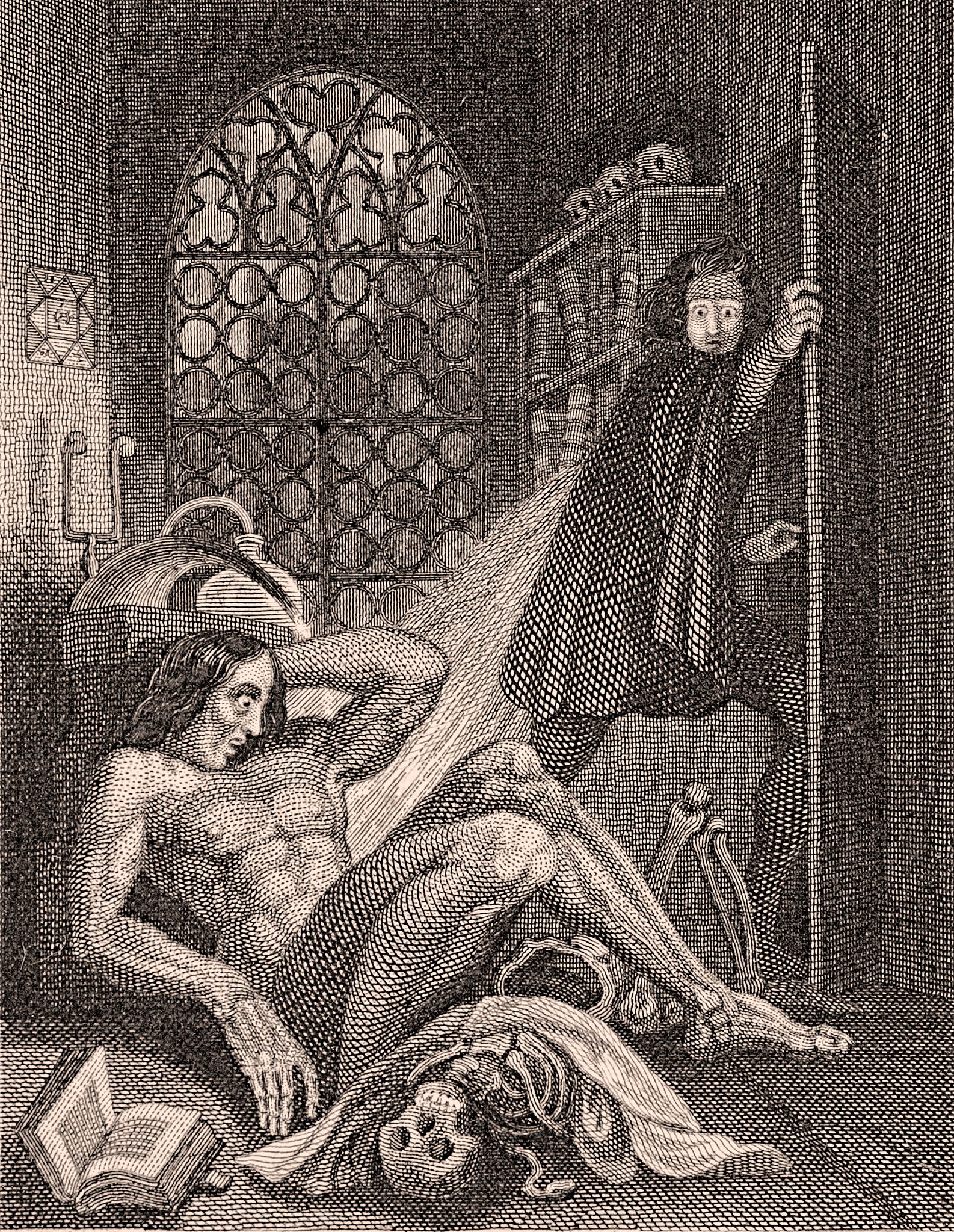
After watching the new Frankenstein movie this weekend, I decided to correct something. I’d never read the original novel by Mary Shelley. I was familiar with the overall story, but I think it came from reading a comic book adaptation at some point decades ago, one I knew was heavily abridged.
A key question upfront was which version to read: the original 1818 version, or the later 1831 edition? The Wikipedia article implies that the 1831 version was heavily revised, smoothing out some of the radical edges of the original. I decided I wanted the original sensation, the one that caused the initial stir, the version put out by the rebellious teenager, not the more refined version from someone older and perhaps more cautious. (I did skim the 1831 edition a bit, but didn’t see any immediately noticeable differences in key scenes. And Shelley herself claimed her only changes were stylistic.)
I don’t usually read fiction written prior to the 1900s. Often it’s just too much of a slog. I was worried it would be an issue in this book, but Frankenstein is not long, and I didn’t find the writing difficult. The language is formal, and the dialogue stilted in that the characters make speeches rather than actual conversation. But overall the pacing works. There were a few places where Shelley seems to be writing more of a travelogue than a fiction story, but it’s usually to prolong a feeling of suspense for an event we’re anticipating.
Shelley uses a nested frame structure, which starts off in epistolary mode with letters from a ship captain, then goes into first person with Victor Frankenstein telling his story to the ship captain. Later in the book we get the creature’s viewpoint when he tells his story to Victor, who in turn relays it to the captain. All of which in a modern novel would likely just be handled with multiple third person limited or labeled first person viewpoints.
But when reading a two hundred year old book, some allowances do have to be made. That’s particularly true for something that’s been adapted so many times. As expected, it’s both less and more of the Frankenstein myth we’ve all become used to. Less, in the sense that a lot of what we associate with the story is absent. There’s no castle with a tower and lightning rod, and the creature isn’t assembled from body parts. It’s constructed in a makeshift lab in Victor Frankenstein’s university apartment.
Of course, the movies add the other stuff to dramatize the event. That dramatization in the book comes from describing the extensive studies in natural philosophy Victor undergoes in preparation. The actual construction is narratively brief, utilizing a principle of life Victor says he discovered, but won’t reveal because the knowledge is too dangerous. Throughout the book, he refers to his “chemical instruments” as the necessary tools for creating life.
It’s this focus, however brief, on the creation of life coming from discovered natural philosophy (scientific) principles, rather than reference to something occult or supernatural, that leads many to say Frankenstein is the first science fiction novel. Which is one of the reasons I wanted to read it. I do think it qualifies as science fiction, but it doesn’t feel sci-fi in the way Jules Verne or H.G. Wells’ later stories would. It’s feel in most of the story matches its traditional classification: gothic horror.
The creature is also different in a number of ways from how he’s often portrayed in movies.
His limbs were in proportion, and I had selected his features as beautiful. Beautiful!— Great God! His yellow skin scarcely covered the work of muscles and arteries beneath; his hair was of a lustrous black, and flowing; his teeth of a pearly whiteness; but these luxuriances only formed a more horrid contrast with his watery eyes, that seemed almost of the same colour as the dun white sockets in which they were set, his shrivelled complexion, and straight black lips.
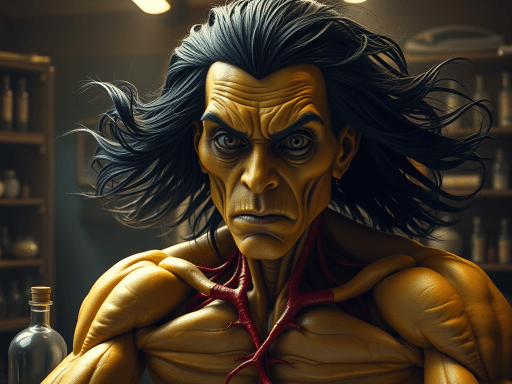
Our view of the creature in its initial state is also very brief. Most of our exposure is to a later very articulate person, although he describes to Victor his climb from a fully grown newborn, unable to make sense of the world, into a more educated entity. He’s also more villainous in the book, a ruthless cold blooded murderer. Shelley makes clear he commits these acts only after a long history of the world never giving him a chance, of repeatedly deciding on sight that he’s a monster. No one in the book treats him with sympathy. Victor comes close at one point, but it’s glancing. Still, the murders make him less sympathetic than the movie versions.
Not that Victor is particularly sympathetic either. In the recent movie this is due to his blind arrogance. In the book it comes from him being repulsed by his own creation, and refusing to take meaningful responsibility for it. He spends most of the book overwrought, feeling guilty, wringing his hands in horror, with the occasional nervous breakdown mixed in. He only regains agency after a lot of tragedy, and then his motivation is revenge.
It never occurs to Victor to offer his creation protection, to come out publicly about what he is and stand by him so he isn’t alone in the world. He won’t even discuss the creature with anyone else until his revenge stage, after he has lost so much.
But it’s hard to know today if that’s the reaction Shelley wants us to have toward Victor. Some of my reactions may be formed from cultural lessons after her time. Her own account in the introduction to the 1831 edition speaks to the hubris of playing God. But mostly it seemed she just wanted to create a truly terrifying tale.
Given the impact her work has had, it’s hard to argue she didn’t succeed. If her book today doesn’t chill as much as we think it should, it’s only because the tale has been revisited and amplified so many times. It’s impossible for us experience it as someone in 1818 would have. Still, I was surprised by how good a read it turned out to be.
 SelfAwarePatterns
I just watched that a couple nights ago, thank you for such a concise breakdown 😊
LikeLiked by 1 person
Remote Reply
Original Comment URL
Your Profile
Why do I need to enter my profile?
This site is part of the ⁂ open social web, a network of interconnected social platforms (like Mastodon, Pixelfed, Friendica, and others). Unlike centralized social media, your account lives on a platform of your choice, and you can interact with people across different platforms.
By entering your profile, we can send you to your account where you can complete this action.
Thanks. I enjoyed the movie too.
LikeLike
Kudos to you on taking the time to compare our version to the original book. I find that sort of thing gratifying. It’s nice when some very old thing that we think will probably bore us turns out to be interesting. I felt that way about watching Nosferatu. I fully expected not to be impressed by the primitive effects, but somehow they were impressive and created an incredible atmosphere.
LikeLiked by 1 person
Thanks!
Was that the silent version of Nosferatu? I’ve only seen brief minutes, although I was impressed by how creepy they were. Something about the silence in a lot of the horror from that era magnifies their effect, at least for me. It was also pre-code, so they covered things motion pictures wouldn’t be allowed to touch again for several decades.
My cousin said the recent remake is good too. Supernatural horror is less interesting to me, although when it’s well done I can still sometimes enjoy them for the worldbuilding.
LikeLike
Yeah, the silent film. I thought that aspect of it would annoy me, but it really didn’t. It’s a very different sort of experience though.
I started to watch the remake, but I couldn’t get into it. Of course, it was nothing like the silent film. Something about the original was beautifully done, though I can’t put my finger on what it was. Maybe it was that it didn’t treat the subject matter so seriously, so it felt a lot less like a horror film and more like a work of art and an exploration of film techniques to create a certain aesthetic or atmosphere.
LikeLike
I know what you mean. I enjoyed “Bram Stoker’s Dracula”, not because I found it scary, but because of the visuals, its reimagining of how Dracula looked and acted. I have no idea how well it would hold up today. But it seemed like a break from the campy versions I watched as a kid.
The silent Noferatu was completely outside of the old traditional way of presenting Dracula. Although some of that came from changes to avoid being sued by Stoker’s widow, which didn’t work since she sued anyway. Kind of ironic that it’s now recognized as a seminal work of art.
LikeLike
Interesting about the widow. I had no idea about that. I figured it was just a stylistic choice not to make the Dracula theme quite so explicit.
LikeLike
There’s a short documentary somewhere on its making, the lawsuit, and the fact that all copies were supposed to have been destroyed, although obviously some survived. I caught it late one night years ago on some cable channel. It’s where I saw those snippets.
LikeLike
I originally read Frankenstein in high school, and the pop culture version of Frankenstein meant my expectations were extremely low. It’s now one of my top ten favorite books. I somehow never knew about the two different editions. I have several copies in my library, so I’ll have to see which edition I have, or if I have both.
LikeLiked by 1 person
From what I’ve read, the 1831 edition is the most common, the thinking being it was Shelley’s preferred version. And skimming it after I finished the 1818 one, I suspect there’s no material difference, despite what Wikipedia says. But it is cool that Gutenberg has both. (Less cool that they don’t clearly label them.)
LikeLiked by 1 person
It turns out that I have both. I have a nice, fancy, leather bound version that says it’s the 1818 edition. I also have a paperback copy, and that’s the 1831 edition.
LikeLiked by 1 person
Bram Stoker’s Dracula is worth a read, too, if you haven’t already. It’s interesting to compare the original after so many adaptations.
If you can find them, Fred Saberhagen wrote two books taking on the Frankenstein and Dracula stories from the creatures’ point of view. (Turns out the whole Jonathan Harker mess was a complete misunderstanding.) The Frankenstein Papers and The Dracula Tape.
Saberhagen went on to write several more books starring his Count Dracula. Adventures that take him to the modern era. Haven’t read them in decades but remember liking them a lot.
LikeLiked by 1 person
I think I saw that there’s a new Dracula movie in the works, so that might eventually spur me to read the original. One thing I like about the Dracula story is it seems to move beyond the horror stage into an action/adventure mode, at least based on Bram Stoker’s Dracula and other book adaptations I’ve seen.
I haven’t read Saberhagen in a long time. Those sound pretty interesting. And it looks like they’re available on Kindle! I’ll definitely keep them in mind. Thanks!
LikeLiked by 1 person
Saberhagen was one of those authors I read just about everything he wrote. As you probably recall, he wrote both good fantasy (The Swords series, for instance) and good SF.
His Frankenstein and (first) Dracula books are among my favorites because he retells the Shelley and Stoker stories very accurately, but from the “monster’s” point of view.
LikeLiked by 1 person
I remember his Empire of the East series, but mostly I remember him for the Beserker concept and stories. The Frankenstein and Dracula books do sound interesting.
LikeLiked by 1 person
Your point about choosing the 1818 version to get the “rebellious teenager” sensation is a great one—it really frames the book as a product of its specific, radical moment. The creature’s eloquent first-person account was the part that truly humanized the story for me, far more than any film adaptation has managed.
LikeLiked by 1 person
Thanks. As I noted in the post, I’m not sure the editions are really all that different from each other, but I wanted the original, just in case.
Given the way the movies usually portray the creature, I was a bit surprised to see us jump immediately to a fully articulate version. I agree. His eloquence in the book demonstrated his humanity.
LikeLike