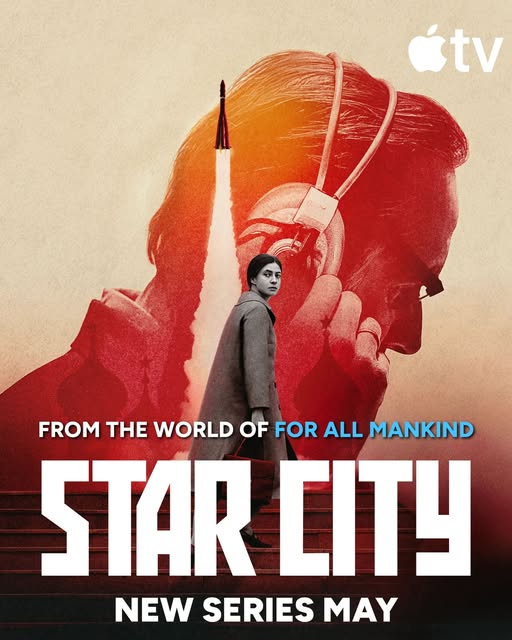
I was leery of the show For All Mankind for a long time. The promotional material made it sound more like a political drama than a space adventure. And sure enough, the first time I tried to watch it a few years ago, I largely ran aground on all the domestic soap opera. But the show receives a lot of accolades, which finally led me to try again. I picked up where I’d left off in the first season and powered through, and was pleasantly surprised by season climax.
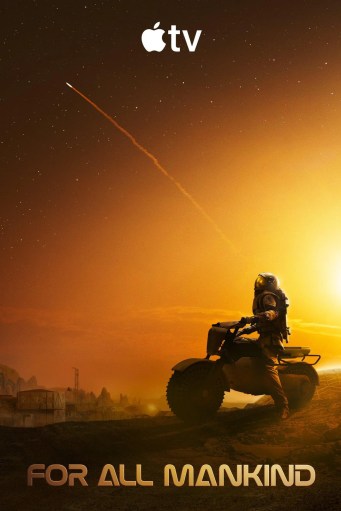
Season 2 also has its share of domestic drama, but it felt more tolerable. A substantial portion of the drama happens on the moon, which for me at least, always helps. But it’s in the third season where the show really starts to feel like science fiction, as the balance of the story starts shifting to Mars.
The premise is that in 1969 the Soviets actually beat America to the moon, which keeps the space race going. The overall story is an alternate history of the last sixty years that looks a lot like what futurists and science fiction nerds of the 1960s and early 70s thought would happen. The Soviets follow up by putting a woman on the moon, which incites America to open its astronaut corps to women much earlier than in our timeline. And the Soviet Union stays viable far beyond the 1980s.
The result is competing moon bases in the 1970s and 80s, which of course leads to tensions and eventually outright combat on the moon. In the 1990s, there is a race for Mars, which is complicated by a private space company entering the race. In the 2000s, an asteroid rich in iridium is discovered which adds an economic incentive for the whole space infrastructure, all of which eventually culminates in that now standard sci-fi trope, a movement for an independent Mars.
The story is told through a fairly large cast of characters, which initially focuses on astronauts, flight engineers, and their families, but then widens out as the series progresses. Many characters get killed and others age out.
Star City is a spinoff series. It’s in the same universe, but now told from the Soviet perspective. We see young versions of a couple of the Russian characters that eventually show up in For All Mankind. Like the original show, there’s a lot of soap opera drama, but within the context of a police state, making the stakes life and death, and giving the show a spy thriller feel. In this alternate timeline, Brezhnev era Russia still feels a lot like the Stalinist period.
Irina is a young KGB employee who spends most of her time listening to and making notes on clandestine audio recordings of cosmonauts and their families. Irina’s superior, Raskova, looks and acts like Colonel Rosa Klebb in From Russia with Love. The Soviet Chief Designer, who died in 1966 in our timeline, is still alive and guiding the Soviet space program.
Someone has leaked the design of the Soviet moon base to the Americans, and manages to install a spy device on the spacecraft that carries the first female cosmonaut to the moon. Raskova is determined to find out who the leak is, and ends up arresting one of the female cosmonauts. But Irina suspects she is innocent. When she is able to establish that innocence, she learns something about the organization she works for.
While it took effort for me to get through the first two seasons of For All Mankind, the payoff in subsequent seasons turns out to be more than worth it. That show has five seasons out now, which takes it into the 2010s. The sixth and final season will take it into the 2020s, bringing it more or less to that timeline’s version of today.
The show does a pretty good job of highlighting various aspects of space travel and habitats. There’s an episode where a hotel in space, which spins to produce artificial gravity, is damaged by debris which causes one of its thrusters to begin firing, causing the spin to increase to the point where the entire structure is in danger of coming apart. Another series of episodes hinge on aspects of orbital mechanics. And I’m delighted that it always resists to urge to have sound in space.
But it’s not always accurate. The second season shows astronauts flying to the moon in the space shuttle, completely unrealistic given that vehicle’s design. And we see people flying between locations on the moon and on Mars in craft which, while accurately portraying that they would need to use thrust just to maintain altitude, seems unrealistic about how long that could be maintained.
Some of it I’m okay giving the show a break on, like people inside on the moon and Mars moving around like they’re in regular gravity. Getting that right would be prohibitively expensive. But the rest seems it could have been corrected with modest adjustments.
Of course, nothing’s perfect, and on balance I enjoyed the series. I’ll definitely be watching the last season when it comes out.
I’m also enjoying Star City, which is still in its first season, six episodes in at this point. It’s separate enough that it could be watched even if you haven’t seen For All Mankind, although you’d miss out on the significance of some of the characters.
Have you seen either of these shows? Or watched anything else interesting lately?
 SelfAwarePatterns
Is this something you’d think about re-watching in 5-10 years? Or is it a one and done kind of thing for you?
LikeLiked by 2 people
I rarely rewatch things, and when I do it’s usually a movie or something else that doesn’t take too much of a time commitment. An exception is stuff that comes on live TV when I just want something playing in the background, but then I’m usually not paying too much attention.
LikeLiked by 1 person
Thanks for explaining 🙂
LikeLiked by 1 person
@selfawarepatterns.com But the “political drama” and “domestic drama,” helped along by some middlin’-to-occasionally-verging-on-good acting, is largely what makes the show interesting. Otherwise it’s just a series of set-piece scenarios.
LikeLiked by 1 person
Remote Reply
Original Comment URL
Your Profile
Why do I need to enter my profile?
This site is part of the ⁂ open social web, a network of interconnected social platforms (like Mastodon, Pixelfed, Friendica, and others). Unlike centralized social media, your account lives on a platform of your choice, and you can interact with people across different platforms.
By entering your profile, we can send you to your account where you can complete this action.
I guess it depends on how much of a space nerd you are. I also would have preferred the drama to be more action oriented. But obviously this is all very subjective.
LikeLike
@selfawarepatterns.com The main reason I rarely can watch TV-series. All the interesting stuff gets interrupted with drama and romance. I always say: get on with it!, and then stop watching.
LikeLiked by 1 person
Remote Reply
Original Comment URL
Your Profile
Why do I need to enter my profile?
This site is part of the ⁂ open social web, a network of interconnected social platforms (like Mastodon, Pixelfed, Friendica, and others). Unlike centralized social media, your account lives on a platform of your choice, and you can interact with people across different platforms.
By entering your profile, we can send you to your account where you can complete this action.
You might enjoy Star City more. Still lots of drama and romance, but with much higher stakes.
LikeLike
@selfawarepatterns.com Does the series postulate that somehow the N1-L3 worked, or that an alternate launcher like Chelomei's UR-700 was used? Where is the point of counterfactual departure?
LikeLiked by 2 people
Remote Reply
Original Comment URL
Your Profile
Why do I need to enter my profile?
This site is part of the ⁂ open social web, a network of interconnected social platforms (like Mastodon, Pixelfed, Friendica, and others). Unlike centralized social media, your account lives on a platform of your choice, and you can interact with people across different platforms.
By entering your profile, we can send you to your account where you can complete this action.
We don’t get the technical details of the Soviet program in the shows, although a sharp eye might be able to tell from the launch scenes in Star City. From what I’ve read, the show producers identify divergence as the death of Sergei Korolev, the Soviet Chief Architect. Instead he survives and continues guiding the program, and is actually a major character in Star City.
LikeLiked by 1 person
I just finished Season 5 of For All Mankind. I liked it but more importantly my wife liked it and it’s hard to get her to watch a lot of SciFi.
The space shuttle to the Moon didn’t bother me too much. The original shuttle was much smaller than the huge oversized size one that got built by NASA, partly because they intended to use the shuttle to launch military satellites. So, it is probably a stretch that even the small original shuttle could go beyond Earth orbit but it isn’t as much of a stretch as the one they actually built would be. But, this is another timeline and who knows what NASA might have built in a different history.
LikeLiked by 2 people
I think you zero in on the reason for the domestic drama. It widens the audience. (It also narrows it, but maybe it brings in more people than it loses. Although I know people who still haven’t watched it for the same reason I didn’t.)
The other timeline aspect occurred to me, but what they showed looked like our shuttle (at least until the special one at the end of the season), including with the same launch system. That launch system doesn’t have the oomph to boost it beyond low Earth orbit. But even if separate docked orbital boosters were used, the shape of the craft is a problem. A winged craft can’t withstand the pressure from reentry with the speed it would have falling from the moon’s orbit. As I understand it, the wings would come off, at least if it was made from alloys light enough for its launch system.
I suspect the producers knew this, and just reasoned that most people wouldn’t know or care. And showing the shuttle helped anchor the audience in the time period. I understand why they did it, but the nerd in me sees it as an ugly compromise.
The other timeline answer does work better from the third season on, since it’s new technology at that point.
LikeLiked by 2 people
“A substantial portion of the drama happens on the moon, which for me at least, always helps.”
Same.
I remember wanting to watch this when the first season came out, but I never got around to it for some reason, and then I never heard about it again. I assumed it was canceled. I’m delighted to find out that I was wrong about that. Five seasons and a spinoff sounds great!
LikeLiked by 1 person
I think you’d enjoy it, at least the portions that take place in space. I wish that was a bigger portion, but as someone else pointed out, the domestic soap opera aspects do bring in a larger audience. And it increasingly shifts towards Mars as the show progresses.
LikeLiked by 1 person