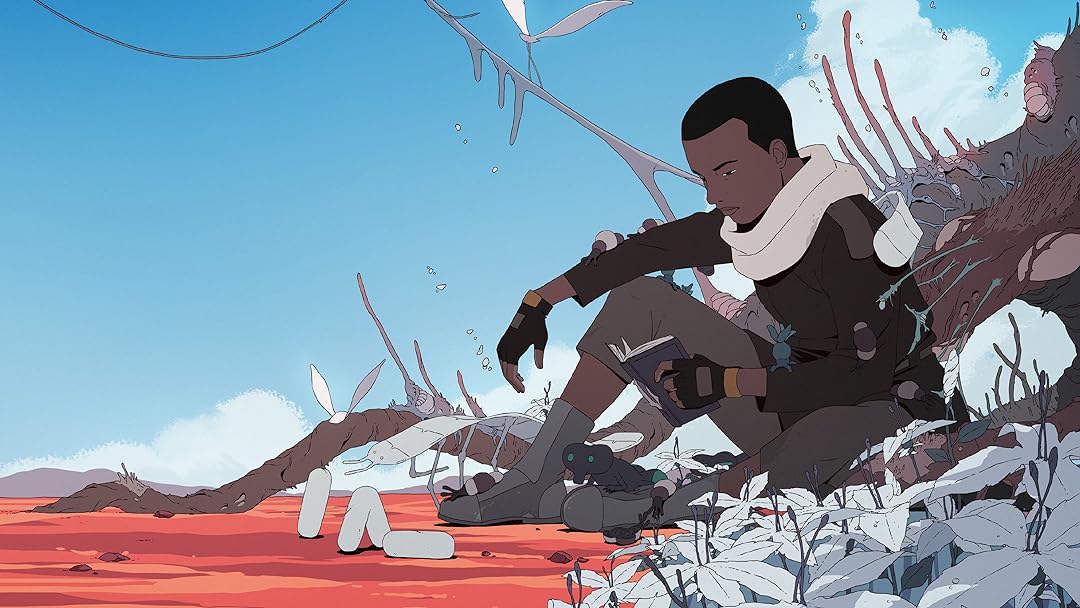
This week I came across Scavenger's Reign, a sci-fi animated series on Netflix. The show is about a crew stranded on an alien planet, Vesta, with an interesting ecosystem. It chronicles the efforts of isolated groups to survive. The groups have little hope of a rescue. It's revealed upfront that the company they work for … Continue reading Scavenger’s Reign, and other TV notes
The myth of left and right
I've written before that I think the idea of politics as happening between different philosophical schools is misguided. In this interview on The Dissenter podcast, Hyrum Lewis often strikes me as criticizing the left more than the right, but I think his thesis is basically sound. "Left" and "right" as concepts can be misleading when … Continue reading The myth of left and right
The scope of free will
Maybe the free will debate is really about the scope of causal influences on our decisions. With Daniel Dennett's death, a lot of podcasters have been replaying his interviews, many of which concern his stance as a free will compatibilist. That and a recent Mind Chat episode focused on Kevin Mitchell's strong emergence understanding of … Continue reading The scope of free will
Doctor Who, science fiction and fantasy
The new Doctor Who season is starting off with maximum silliness, and an emphasis on fantasy over science fiction. One nice benefit of Doctor Who moving to Disney+ (at least in the US) and being available for streaming first, even in the UK, is that the episodes now drop for me on Friday evenings, a … Continue reading Doctor Who, science fiction and fantasy
Consciousness must be adaptive
The New York Declaration on Animal Consciousness has been making a lot of headlines. The declaration itself has somewhat careful language in terms of what it's asserting, but many of the headlines don't. The declaration is short, so it's easy to quote in full. Which animals have the capacity for conscious experience? While much uncertainty … Continue reading Consciousness must be adaptive
Some thoughts on Daniel Dennett’s ideas
Yesterday Daniel Dennett died. He was 82, about the same age as my father when he died a few years ago. I think I've mentioned before that the first writer I read on consciousness was Susan Blackmore. But I know Dennett wasn't far behind, likely based on Blackmore's positive discussions of his work, but also … Continue reading Some thoughts on Daniel Dennett’s ideas
Fallout
Fallout, like many recent TV shows, demonstrates the old rule, of video game adaptations always being awful, is obsolete. At first Fallout seems similar to a lot of other post-apocalyptic shows. There's been a nuclear war and the world is a wasteland. Life on the surface is a brutal battle for survival, even two hundred … Continue reading Fallout
Halo
Shows based on video games have gotten better in recent years, and Halo seems to fit this trend. I never got into the games, so my knowledge of the premise only comes from the show. Humanity is at war with an alien civilization known as the "Covenant". The Covenant seems determined to eradicate humanity for … Continue reading Halo
3 Body Problem
The TV show, 3 Body Problem, is an adaptation of Liu Cixin's novel, The Three Body Problem. I read Cixin's book several years ago, back when it was up for the Hugo Award, which it eventually won. The book explores a lot of ideas, such as the difficulty in making predictions with inherently chaotic systems, … Continue reading 3 Body Problem
Blade (Inverted Frontier Book 4)
Blade is the penultimate book in Linda Nagata's Inverted Frontier series. I've written about this series many times. It's a sequel to her earlier series: The Nanotech Succession. These books describe a civilization that has mastered nanotechnology, to the extent that mind uploading and new bodies on demand are possible, so everyone is essentially immortal. … Continue reading Blade (Inverted Frontier Book 4)