Sean Carroll's latest episode of his podcast, Mindscape, features an interview with neuroscientist Malcom MacIver, one that is well worth checking out for anyone interested in consciousness. Consciousness has many aspects, from experience to wakefulness to self-awareness. One aspect is imagination: our minds can conjure up multiple hypothetical futures to help us decide which choices … Continue reading Malcolm MacIver on imagination and consciousness
Tag: Brain
A neuroscience showdown on consciousness?
Apparently the Templeton Foundation is interested in seeing progress on consciousness science, and so is contemplating funding studies to test various theories. The stated idea is to at least winnow the field through “structured adversarial collaborations”. The first two theories proposed to be tested are Global Workspace Theory (GWT) and Integrated Information Theory (IIT). GWT … Continue reading A neuroscience showdown on consciousness?
The sensorium, the motorium, and the planner
I've been reading Gerhard Roth's The Long Evolution of Brains and Minds. This a technical and, unfortunately, expensive book, not one aimed at general audiences, but it has a lot of interesting concepts. A couple that Roth mentions are the terms "sensorium" and "motorium." The sensorium refers to the sum total of an organism's perceptions, … Continue reading The sensorium, the motorium, and the planner
Maybe the brain communicates via electrical fields after all
An interesting finding by scientists at Case Western Reserve University, that neurons may communicate via electrical fields: Scientists think they've identified a previously unknown form of neural communication that self-propagates across brain tissue, and can leap wirelessly from neurons in one section of brain tissue to another – even if they've been surgically severed. ...To … Continue reading Maybe the brain communicates via electrical fields after all
Did smell lead to consciousness?
Smell has apparently always been a peculiar sense. The sensory pathway of smell information to the brain runs completely independent from the other senses. The pathways for the other senses run through the midbrain and thalamus and are then relayed to cortical regions. But smell goes to the olfactory bulb behind the nose, and from … Continue reading Did smell lead to consciousness?
When does personhood begin?
Gary Whittenberger has an article at Skeptic on discussing personhood and abortion: The pro-person position, as I have outlined it in this essay, recognizes the late fetus and the host woman both as persons with human rights. When these rights come into conflict, as can occur during the last 15 weeks of pregnancy, then the … Continue reading When does personhood begin?
Is the brainstem conscious?
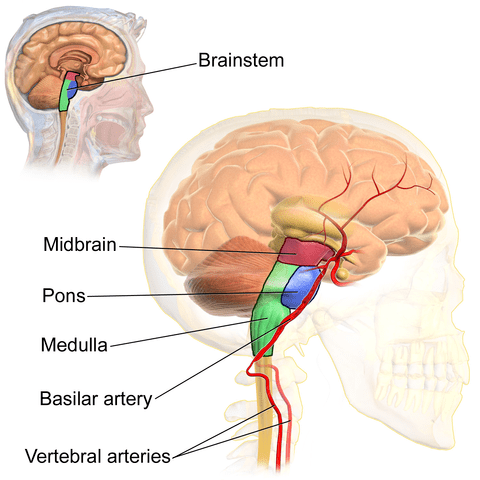
(Warning: neuroscience weeds and references to gruesome animal research.) The vast majority of neuroscientists see consciousness as a cortical phenomenon. It may be crucially dependent on sub-cortical and sub-cerebral structures, but subjective experience itself exists mainly or entirely in the neocortex. In this view, the brainstem only produces reflex responses, with anything more sophisticated coming … Continue reading Is the brainstem conscious?
Strong vs weak emergence
The Neuroskeptic has an interesting post on a paper challenging theories of mind based on strong emergence. A new paper offers a broad challenge to a certain kind of ‘grand theory’ about the brain. According to the authors, Federico E. Turkheimer and colleagues, it is problematic to build models of brain function that rely on ‘strong … Continue reading Strong vs weak emergence
Consciousness lies in the eye of the beholder
There are few things that everyone who ponders consciousness can agree on. It's a topic where debates on the very definition of the subject are common. The only definitions that seem to command near universal assent are the ones oriented toward phenomenology, such as "subjective experience" or "something it is like." And even then, the … Continue reading Consciousness lies in the eye of the beholder
Blindsight explained and conscious perception
Warning: neuroscience weeds. Every so often we get into discussions about where in the brain consciousness lies. Sometimes it's asserted to be in the brainstem, other times in the thalamus, sometimes in the parietal lobe, and yet other times in the prefrontal cortex. Myself, I've concluded that conscious perception requires activation of a network including … Continue reading Blindsight explained and conscious perception
 SelfAwarePatterns