Does reality require observers?

Amanda Gefter has an article at Nautilus a couple of you have asked me about: Reality Exists Without Observers? Boooo! The title is an accurate summary of her thesis. Gefter is responding to a book by Vlatko Vedral, where he reportedly argues for a reality that doesn't require observers. In terms of quantum mechanics, Vedral … Continue reading Does reality require observers?

What physicists believe about quantum mechanics

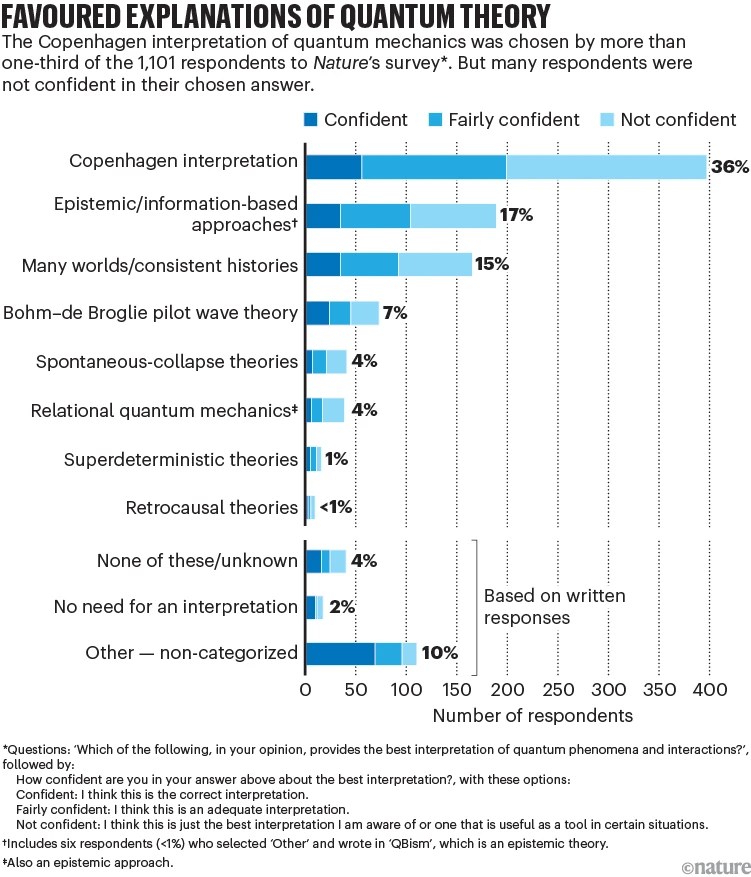
A few years ago David Bourget and David Chalmers did a follow up survey to the 2009 one polling philosophers on what they believe about various questions. One of them was quantum mechanics, particularly the measurement problem and its various interpretations. Over the decades there have been surveys of physicists themselves on this question, but … Continue reading What physicists believe about quantum mechanics

Is quantum immortality a real thing?

In discussions about the Everett interpretation of quantum mechanics, one of the concerns I often see expressed is for the perverse low probability outcomes that would exist in the quantum multiverse. For example, if every quantum outcome is reality, then in some branches of the wave function, entropy has never increased. In some branches, quantum … Continue reading Is quantum immortality a real thing?

Many-worlds without necessarily many worlds?

IAI has a brief interview of David Deutsch on his advocacy for the many-worlds interpretation of quantum mechanics. (Warning: possible paywall.) Deutsch has a history of showing little patience with other interpretations, and this interview is no different. A lot of the discussion centers around his advocacy for scientific realism, the idea that science is … Continue reading Many-worlds without necessarily many worlds?

Avoiding the structural gaps

A long standing debate in quantum physics is whether the wave function is real. A quick reminder: quantum entities appear to move like waves, including portions interfering with each other. These waves are modeled with the wave function. But once measured, quantum objects manifest as localized points or field excitations. The wave function can't predict … Continue reading Avoiding the structural gaps

Testing Everettian quantum mechanics

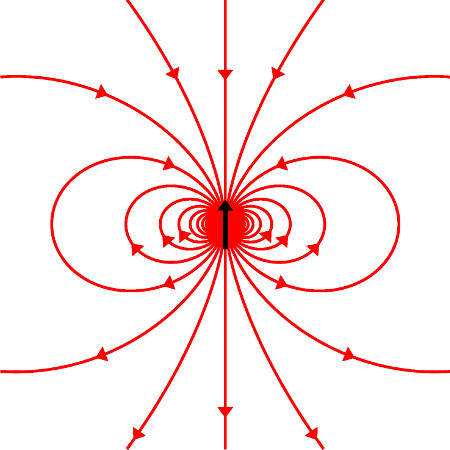
Neutron spin and associated magnetic dipole field lines.

The Everett theory of quantum mechanics is testable in ways most people don't realize. Before getting into how or why, I think it's important to deal with a long standing issue. Everettian theory is more commonly known as the "many worlds interpretation", a name I use myself all the time. But what's often lost in the discussion … Continue reading Testing Everettian quantum mechanics

Those inconvenient quantum interference patterns

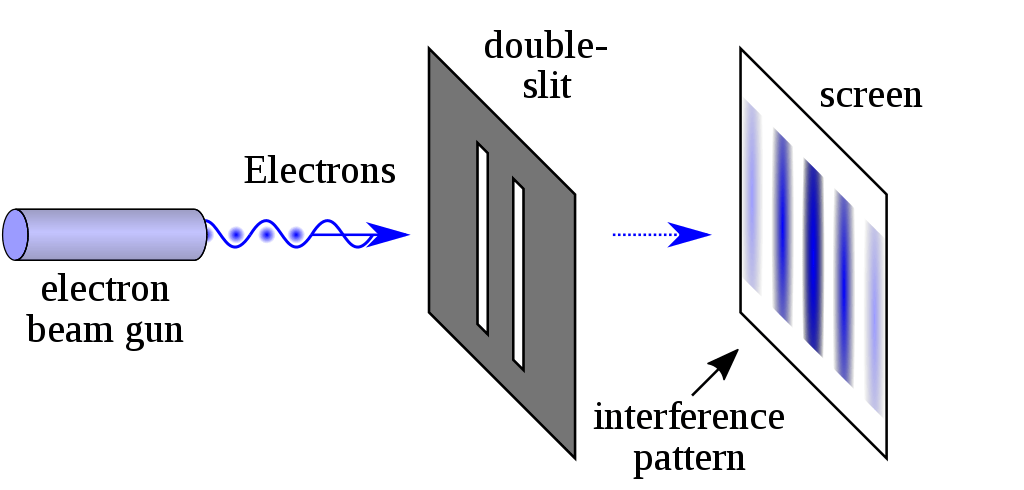
Are quantum states and the overall wave function real? Or merely a useful prediction tool? The mystery of quantum mechanics is that quantum objects, like electrons and photons, seem to move like waves, until they're measured, then appear as localized particles. This is known as the measurement problem. The wave function is a mathematical tool for modeling, … Continue reading Those inconvenient quantum interference patterns

Many-worlds, probabilities, and world stacks

In this video, Matt O'Dowd tackles the issue of probabilities in the many-worlds interpretation of quantum mechanics. A quick reminder. The central mystery of quantum mechanics is that quantum particles move like waves of possible outcomes that interfere with each other, until a measurement happens, when they appear to collapse to one localized outcome, the … Continue reading Many-worlds, probabilities, and world stacks

Are many-worlds and pilot-wave the same theory?

It's been a while, but I've occasionally mentioned on the blog that Cecil B. Demille's The Ten Commandments (the 1950s color version) is one of my favorite movies. And this has remained true even as I've come to see it as straight fantasy. An interesting fact from when I first saw it as a very … Continue reading Are many-worlds and pilot-wave the same theory?

It’s not looking good for objective collapse theories

As noted in the previous post, quantum mechanics is weird. If we try to have a realist understanding of what's happening, it forces bizarre choices about which aspects of common sense reality we throw under the buss. The central mystery is the wave function collapse. Quantum particles move like waves, mathematically described by the wave … Continue reading It’s not looking good for objective collapse theories