An interesting paper by Matthias Michel on the underdetermined nature of theories of consciousness. Consciousness scientists have not reached consensus on two of the most central questions in their field: first, on whether consciousness overflows reportability; second, on the physical basis of consciousness. I review the scientific literature of the 19th century to provide evidence … Continue reading Consciousness science undetermined
Tag: Neuroscience
To perceive is to predict
Daniel Yon has an interesting piece at Aeon on how our brains predict the outcomes of our actions, shaping reality into what we expect, and why we see what we believe, rather than the other way around. This idea is part of a growing sentiment in the cognitive science community that prediction is at the … Continue reading To perceive is to predict
Rule out plant consciousness for the right reasons
In recent years, there's been a resurgence in the old romantic sentiment that maybe plants are conscious. I hadn't realized that an entire sub-field had formed called Plant Neurobiology, the name itself incorporating a dubious claim that plants have neurons. Although later renamed to the more cautious Plant Signalling and Behavior, it's reportedly still popularly … Continue reading Rule out plant consciousness for the right reasons
The ASSC 23 debate on whether artificial intelligence can be conscious
The ASSC (Association of Scientific Study of Consciousness) had its annual conference on consciousness this week, which culminated in a debate on whether AI can be conscious. Note: the event doesn't actually start until the 28:30 minute mark. The remaining part is about 99 minutes long. http://www.youtube.com/watch?v=97z0OmpTs-Q I was delighted to see the discussion immediately … Continue reading The ASSC 23 debate on whether artificial intelligence can be conscious
Empirical vs Fundamental IIT and the benefits of instrumentalism
The other day, when discussing a paper that criticized IIT (the Integrated Information Theory of consciousness) as unscientific, I noted that IIT, while questionable as the ultimate answer for consciousness, could be useful in the more limited capacity of distinguishing degrees of consciousness in a brain. Apparently I'm not the only one who thinks that, … Continue reading Empirical vs Fundamental IIT and the benefits of instrumentalism
Dehaene’s global neuronal workspace theory
I just finished reading Stanislas Dehaene's Consciousness and the Brain. Dehaene is a French psychologist and cognitive neuroscientist who is bullish on the idea of consciousness being something that can be scientifically investigated. It's an interesting book, one that I recommend for anyone interested in the science of consciousness. Dehaene accomplishes his scientific investigation by … Continue reading Dehaene’s global neuronal workspace theory
The brain is a computer, but what is a computer?
Kevin Lande has an article up at Aeon which is one of the best discussions of the brain as a computational system that I've seen in a while. For an idea of the spirit of the piece: The claim that the brain is a computer is not merely a metaphor – but it is not … Continue reading The brain is a computer, but what is a computer?
A neuroscience showdown on consciousness?
Apparently the Templeton Foundation is interested in seeing progress on consciousness science, and so is contemplating funding studies to test various theories. The stated idea is to at least winnow the field through “structured adversarial collaborations”. The first two theories proposed to be tested are Global Workspace Theory (GWT) and Integrated Information Theory (IIT). GWT … Continue reading A neuroscience showdown on consciousness?
Maybe the brain communicates via electrical fields after all
An interesting finding by scientists at Case Western Reserve University, that neurons may communicate via electrical fields: Scientists think they've identified a previously unknown form of neural communication that self-propagates across brain tissue, and can leap wirelessly from neurons in one section of brain tissue to another – even if they've been surgically severed. ...To … Continue reading Maybe the brain communicates via electrical fields after all
Is the brainstem conscious?
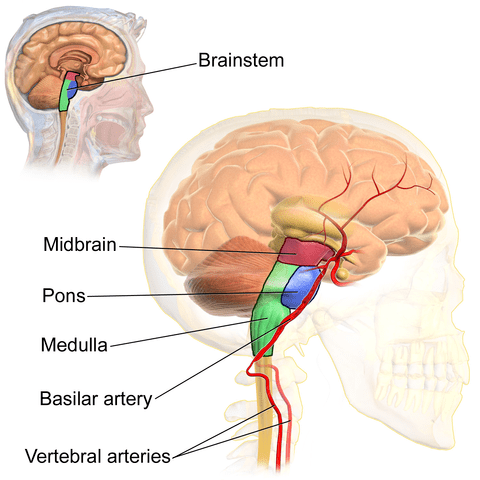
(Warning: neuroscience weeds and references to gruesome animal research.) The vast majority of neuroscientists see consciousness as a cortical phenomenon. It may be crucially dependent on sub-cortical and sub-cerebral structures, but subjective experience itself exists mainly or entirely in the neocortex. In this view, the brainstem only produces reflex responses, with anything more sophisticated coming … Continue reading Is the brainstem conscious?
 SelfAwarePatterns