What is a non-functional account of consciousness supposed to be?

I'm a functionalist. I think the mind and consciousness is about what the brain does, rather than its particular composition, or some other attribute. Which means that if another system did the same or similar things, it would make sense to say it was conscious. Consciousness is as consciousness does. Functionalism has some advantages over … Continue reading What is a non-functional account of consciousness supposed to be?

Manifest and fundamental consciousness

I think the problem of consciousness is primarily one of definition. The word "consciousness" can refer to a range of concepts. Some of the concepts are scientifically tractable, while others, once we clarify them, are metaphysical assumptions that we can either choose to hold or dismiss. This is one of the reasons I find exploring … Continue reading Manifest and fundamental consciousness

Experience and behavior

Common Vampire Bat

Is studying conscious experience different from studying behavior? In a number of recent conversations I've had, the distinction between experience and behavior has come up. There's a strong sentiment that we can study behavior scientifically, including all the intermediate mental states that enable it. But experience is seen as something distinct from that, something that … Continue reading Experience and behavior

Illusionism and functionalism

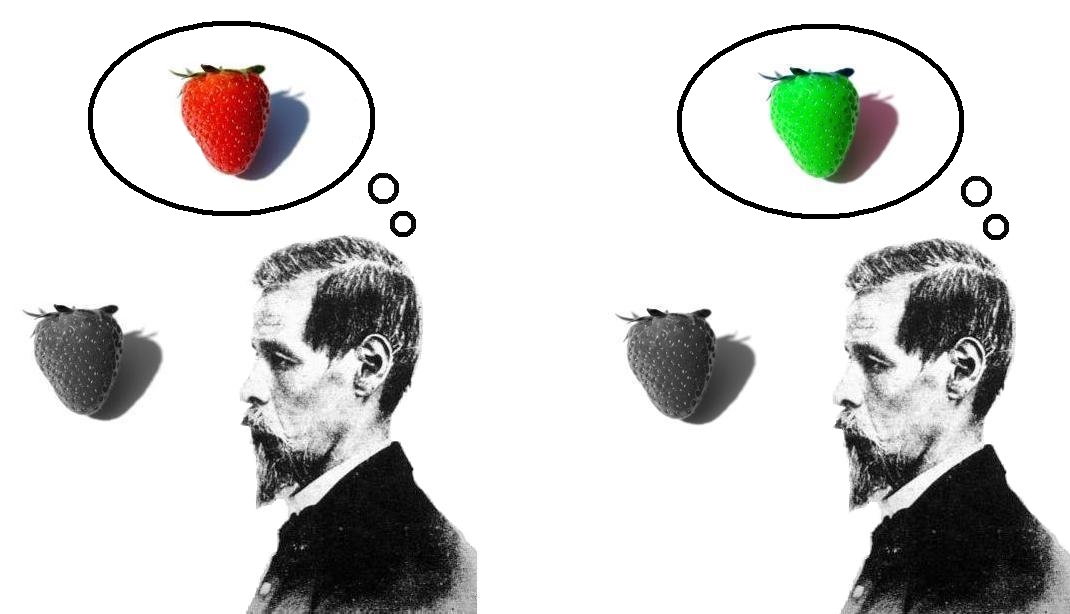
Inverted spectrum: showing one person's perception of a red strawberry equivalent to another's experience of a green one.

In the last thread, someone asked what exactly is it about consciousness that illusionists say is illusory? One quick answer is that for illusionists, the properties people see in experience that incline us to think that consciousness is a metaphysically hard problem, are what's illusory. In weak illusionism, the properties aren't what they seem. In … Continue reading Illusionism and functionalism

Experiencing without knowing?

On Twitter, the Neuroskeptic shared a new paper, in which an Israeli team claims to have demonstrated phenomenal consciousness without access consciousness: Experiencing without knowing? Empirical evidence for phenomenal consciousness without access. A quick reminder. In the 1990s Ned Block famously made a distinction between phenomenal consciousness (p-consciousness) and access consciousness (a-consciousness). P-consciousness is conceptualized … Continue reading Experiencing without knowing?

The function of color

Pencils of all the primary colors in a circle

In the history of discussions about consciousness, there have always been ideas that some aspects of human experience are irreducible to physics. Colors have long had a special place in these discussions. During the scientific revolution, colors lost their status as objective properties in the world, with people like Galileo relegating them to secondary qualities … Continue reading The function of color

Do regular people see a hard problem of consciousness?

This week the latest Mind Chat episode focused on whether regular people actually perceive a hard problem of consciousness, or if it's an issue largely created by philosophers. Keith Frankish and Philip Goff interview Michelle Liu and Edouard Machery. (The video is a bit over two hours. You don't necessarily need to watch it to … Continue reading Do regular people see a hard problem of consciousness?

The debate between phenomenal realism and illusionism, and the scope of perceptual properties

In the last post, I pondered the idea that the real difference between a realist and anti-realist stance toward a scientific theory is about how broad or narrow the scope of the theory might be, about it's domain of applicability. An anti-realist takes a narrower view on scope; such as that the theory can be … Continue reading The debate between phenomenal realism and illusionism, and the scope of perceptual properties

Consciousness, illusions, and definitions

Strawberries

I've discussed many times that the word "consciousness" has a variety of meanings. But most commonly, the various meanings can be grouped into two broad categories. One refers to some combination of functionality, typically the information processing that happens in the brain enabling an organism to take in, assess, and use information about itself and … Continue reading Consciousness, illusions, and definitions