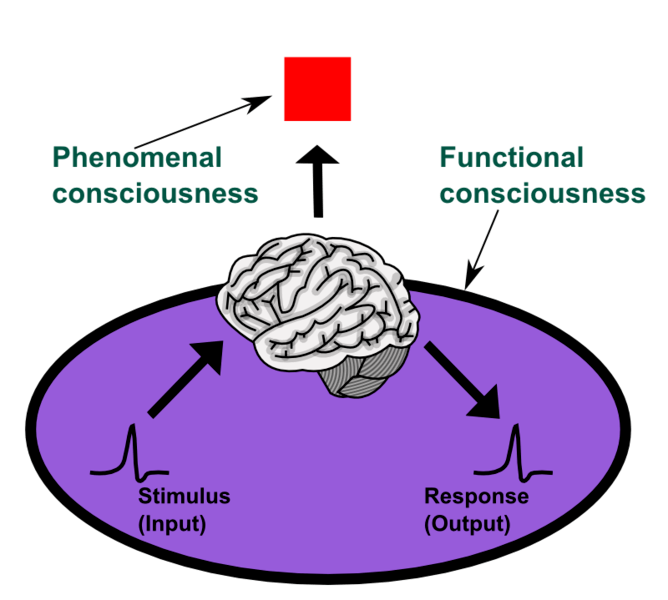
The hard problem of consciousness, a term coined by philosopher David Chalmers, asks how physical systems can produce phenomenal consciousness. Chalmers' term, coined in the 1990s, applied to an older problem that's been around for along time, the mind-body problem. More recently, Chalmers noted his intuition that the hard problem is widely and intuitively held … Continue reading Regular people: What hard problem of consciousness?
Tag: Philosophy of Mind
The complex composition of pain
When I was very young, the top of my feet started itching, so I started scratching. The itching continued for weeks and months, with me constantly scratching. My poor mother, seeing my red and scratched feet, implored me to stop. But the itching was relentless and I was maybe five or six, so I kept … Continue reading The complex composition of pain
The substitution argument
A preprint came up a few times in my feeds, titled: Falsification and consciousness. The paper argues that all the major scientific theories of consciousness are either already falsified or unfalsifiable. One neuroscientist, Ryota Kanai, calls it a mathematical proof of the hard problem. Based on that description, it was hard to resist looking at … Continue reading The substitution argument
Does conscious AI deserve rights?
This is an interesting video from Big Think. It features discussion from a variety of thinkers like Richard Dawkins, Peter Singer, Susan Schneider, and others, including a lot of intelligent remarks from someone I wasn't familiar with until now, Joanna Bryson. https://www.youtube.com/watch?v=ETVr_lpIMO0 Consciousness lies in the eye of the beholder. There is no universally agreed … Continue reading Does conscious AI deserve rights?
There is no phenomenality without access
How do we know whether any particular system is conscious? In humans, we typically know because most humans can talk about their conscious experience. Historically, if we can report on it, it's conscious; if we can't, it's in the unconscious. But this raises a difficulty for any entity that doesn't have language, including non-human animals, … Continue reading There is no phenomenality without access
Are babies conscious?
Infant consciousness seems like a difficult question. It's one people often react to with outrage that it's even being asked. Of course they're conscious, is the sentiment. Aren't they human, and don't we see them crying, showing facial expressions, and exhibiting other behaviors? Others conclude that there's no real way to know since they can't … Continue reading Are babies conscious?
Attention and what we should expect from theories of the mind
Aeon, in their weekend newsletter, highlighted an old article from Carolyn Dicey Jennings on attention and the self. I recall reading this article when it was published, but apparently didn't share or discuss it, I suspect because I had mixed feelings about it. I still do. Consciousness scientists have a tendency to look at attention … Continue reading Attention and what we should expect from theories of the mind
Pain is information, but what is information?
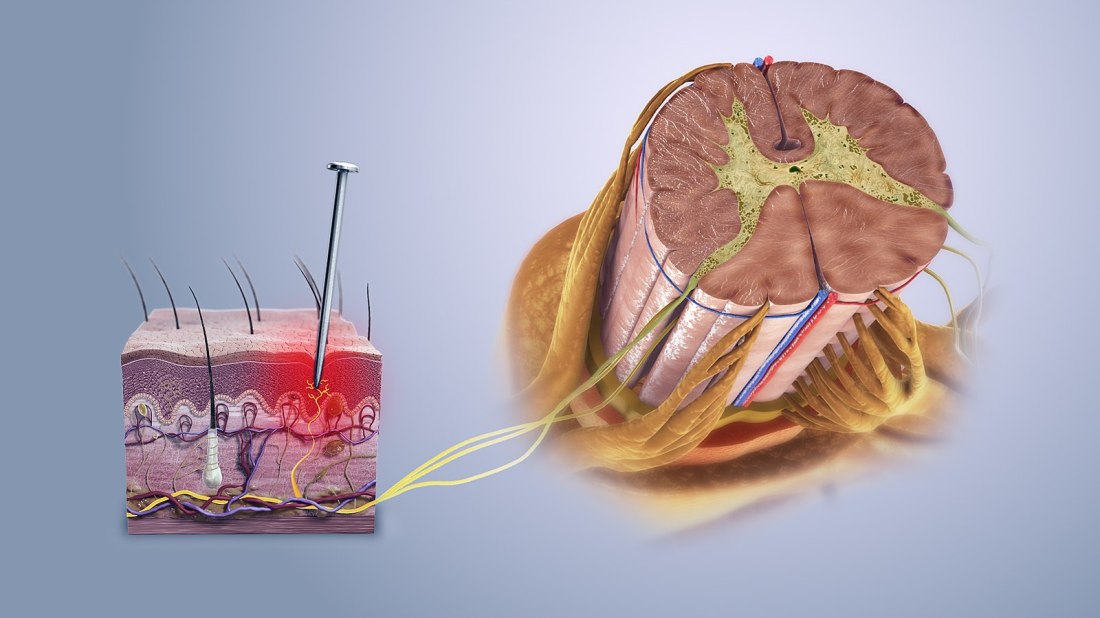
From an evolutionary standpoint, why does pain exist? The first naive answer most people reach for is that pain exists to make us take action to prevent damage. If we touch a hot stove, pain makes us pull our hand back. But that's not right. When we touch a hot surface, nociceptors in our hand … Continue reading Pain is information, but what is information?
Building a consciousness-detector
Joel Frohlich has an interesting article up at Aeon on the possibility of detecting consciousness. He begins with striking neurological case studies, such as the one of a woman born without a cerebellum, yet fully conscious, indicating that the cerebellum is not necessary for consciousness. He works his way to the sobering cases of consciousness … Continue reading Building a consciousness-detector
The issues with biopsychism
Recently, there was a debate on Twitter between neuroscientists Hakwan Lau and Victor Lamme, both of whose work I've highlighted here before. Lau is a proponent of higher order theories of consciousness, and Lamme of local recurrent processing theory. The debate began when Lau made a statement about panpsychism, the idea that everything is conscious … Continue reading The issues with biopsychism