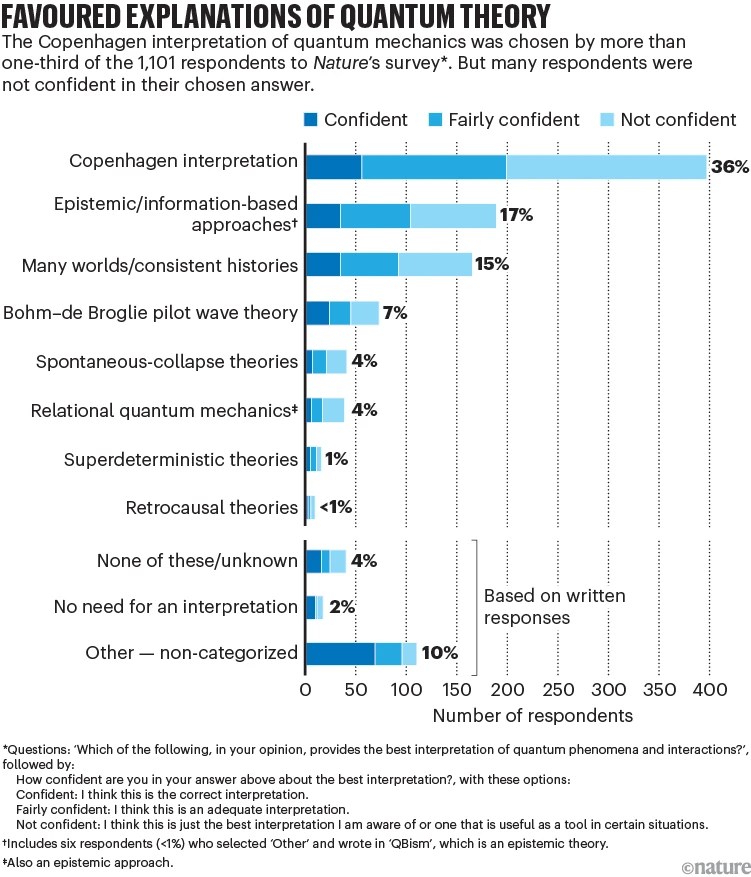
A few years ago David Bourget and David Chalmers did a follow up survey to the 2009 one polling philosophers on what they believe about various questions. One of them was quantum mechanics, particularly the measurement problem and its various interpretations. Over the decades there have been surveys of physicists themselves on this question, but … Continue reading What physicists believe about quantum mechanics
Tag: Philosophy
Is quantum immortality a real thing?
In discussions about the Everett interpretation of quantum mechanics, one of the concerns I often see expressed is for the perverse low probability outcomes that would exist in the quantum multiverse. For example, if every quantum outcome is reality, then in some branches of the wave function, entropy has never increased. In some branches, quantum … Continue reading Is quantum immortality a real thing?
What is it like to be you?
In 1974, in a landmark paper, Thomas Nagel asks what it's like to be a bat. He argues that we can never know. I've expressed my skepticism about the phrase "what it's like" or "something it is like" before, and that skepticism still stands. I think a lot of people nod at it, seeing it … Continue reading What is it like to be you?
What is a non-functional account of consciousness supposed to be?
I'm a functionalist. I think the mind and consciousness is about what the brain does, rather than its particular composition, or some other attribute. Which means that if another system did the same or similar things, it would make sense to say it was conscious. Consciousness is as consciousness does. Functionalism has some advantages over … Continue reading What is a non-functional account of consciousness supposed to be?
Many-worlds without necessarily many worlds?
IAI has a brief interview of David Deutsch on his advocacy for the many-worlds interpretation of quantum mechanics. (Warning: possible paywall.) Deutsch has a history of showing little patience with other interpretations, and this interview is no different. A lot of the discussion centers around his advocacy for scientific realism, the idea that science is … Continue reading Many-worlds without necessarily many worlds?
Reducing felt experience requires not preemptively dismissing the solutions
Annaka Harris has a new audio book out which she is promoting. I haven't listened to it, but based on the interviews and spots like the one below, it appears that she's doubling down on the conclusions she reached in her book from a few years ago, that consciousness is fundamental and pervasive. https://www.youtube.com/watch?v=nP2swgDVl5M The … Continue reading Reducing felt experience requires not preemptively dismissing the solutions
Avoiding the structural gaps
A long standing debate in quantum physics is whether the wave function is real. A quick reminder: quantum entities appear to move like waves, including portions interfering with each other. These waves are modeled with the wave function. But once measured, quantum objects manifest as localized points or field excitations. The wave function can't predict … Continue reading Avoiding the structural gaps
Why I’m an ontic structural realist
Scientific realism vs instrumentalism A long standing debate in the philosophy of science is about what our best scientific theories tell us. Some argue that they reveal true reality, that is, they are real. Others that scientific theories are only useful prediction frameworks, instruments useful in the creation of technology, but that taking any further … Continue reading Why I’m an ontic structural realist
Mind uploading and continuity
As a computational functionalist, I think the mind is a system that exists in this universe and operates according to the laws of physics. Which means that, in principle, there shouldn't be any reason why the information and dispositions that make up a mind can't be recorded and copied into another substrate someday, such as … Continue reading Mind uploading and continuity
What justifies logic?
Jacob McNulty has an article at IAI arguing that the foundations of logic can only be found in metaphysics. (Warning: possible paywall. Alternate link.). He describes a problem called “the logocentric predicament," that any attempt to justify logic with logic ends up being circular, risking an infinite regress. He notes that the most common response … Continue reading What justifies logic?