Does reality require observers?

Amanda Gefter has an article at Nautilus a couple of you have asked me about: Reality Exists Without Observers? Boooo! The title is an accurate summary of her thesis. Gefter is responding to a book by Vlatko Vedral, where he reportedly argues for a reality that doesn't require observers. In terms of quantum mechanics, Vedral … Continue reading Does reality require observers?

What physicists believe about quantum mechanics

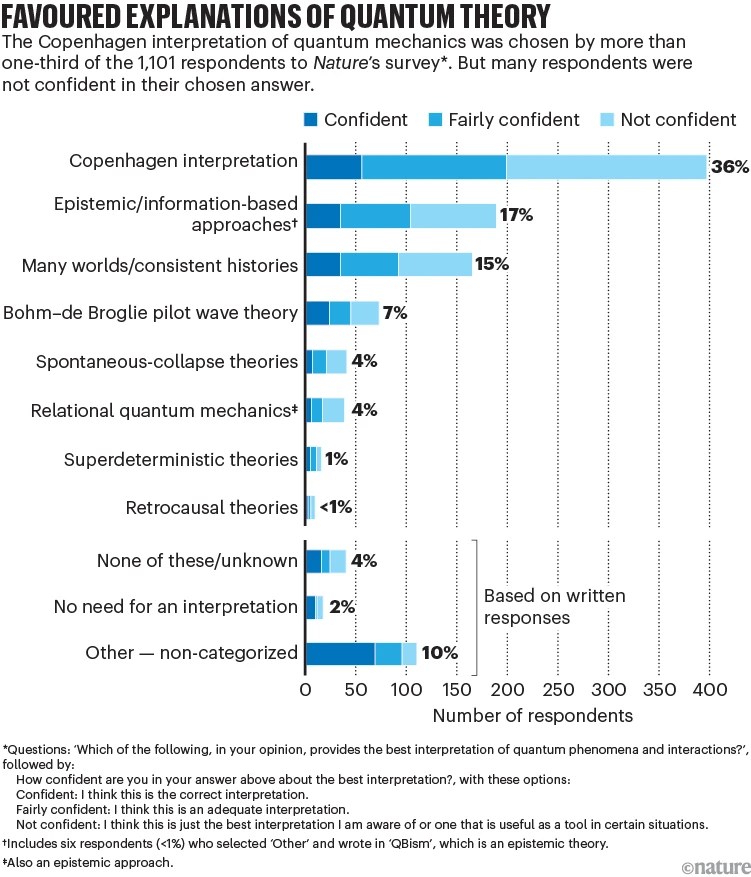
A few years ago David Bourget and David Chalmers did a follow up survey to the 2009 one polling philosophers on what they believe about various questions. One of them was quantum mechanics, particularly the measurement problem and its various interpretations. Over the decades there have been surveys of physicists themselves on this question, but … Continue reading What physicists believe about quantum mechanics

Is quantum immortality a real thing?

In discussions about the Everett interpretation of quantum mechanics, one of the concerns I often see expressed is for the perverse low probability outcomes that would exist in the quantum multiverse. For example, if every quantum outcome is reality, then in some branches of the wave function, entropy has never increased. In some branches, quantum … Continue reading Is quantum immortality a real thing?

Many-worlds without necessarily many worlds?

IAI has a brief interview of David Deutsch on his advocacy for the many-worlds interpretation of quantum mechanics. (Warning: possible paywall.) Deutsch has a history of showing little patience with other interpretations, and this interview is no different. A lot of the discussion centers around his advocacy for scientific realism, the idea that science is … Continue reading Many-worlds without necessarily many worlds?

Cosmic voids and dark energy

Cosmic voids may cause dark energy, or at least provide an explanation for the Hubble tension. A team of Iranian scientists have proposed that dark energy may not be something inherent to space itself, but the result of cosmic voids, vast regions of the universe between galactic superclusters and filaments with relatively little matter.  Paul … Continue reading Cosmic voids and dark energy

Testing Everettian quantum mechanics

Neutron spin and associated magnetic dipole field lines.

The Everett theory of quantum mechanics is testable in ways most people don't realize. Before getting into how or why, I think it's important to deal with a long standing issue. Everettian theory is more commonly known as the "many worlds interpretation", a name I use myself all the time. But what's often lost in the discussion … Continue reading Testing Everettian quantum mechanics

Those inconvenient quantum interference patterns

Are quantum states and the overall wave function real? Or merely a useful prediction tool? The mystery of quantum mechanics is that quantum objects, like electrons and photons, seem to move like waves, until they're measured, then appear as localized particles. This is known as the measurement problem. The wave function is a mathematical tool for modeling, … Continue reading Those inconvenient quantum interference patterns

Is it just the math?

Black hole - Messier 87, a dark center surrounded by the light of an accretion disk

Scientific breakthroughs often begin with someone saying, "Don't panic. This crazy sounding assumption is just to make the math work." Nicholaus Copernicus, when he developed his theory of heliocentrism (the earth orbits the sun), was operating from a scientific realist view. In other words, he thought his system reflected actual reality, or at least reflected it … Continue reading Is it just the math?