Peter Brannen has an interesting piece in the Atlantic, pointing out that the Anthropocene is more of a geological event rather than an epoch, at least so far. Humans are now living in a new geological epoch of our own making: the Anthropocene. Or so we’re told. Whereas some epochs in Earth history stretch more … Continue reading The Anthropocene is a conceit of human exceptionalism
Tag: Science
Consciousness science undetermined
An interesting paper by Matthias Michel on the underdetermined nature of theories of consciousness. Consciousness scientists have not reached consensus on two of the most central questions in their field: first, on whether consciousness overflows reportability; second, on the physical basis of consciousness. I review the scientific literature of the 19th century to provide evidence … Continue reading Consciousness science undetermined
Is cosmology in crisis?
In past posts, when I've written about the expansion of the universe, I've generally referred to the rate of that expansion, the Hubble constant, as being around 70 km/s/megaparsec, that is, for every megaparsec a galaxy is distant from us, it's moving away at 70 kilometers per second faster. So a galaxy 100 megapasecs away … Continue reading Is cosmology in crisis?
Emotions, feelings, and action programs
Sean Carroll's latest Mindscape podcast features an interview with neuroscientist Antonio Damasio: When we talk about the mind, we are constantly talking about consciousness and cognition. Antonio Damasio wants us to talk about our feelings. But it’s not in an effort to be more touchy-feely; Damasio, one of the world’s leading neuroscientists, believes that feelings … Continue reading Emotions, feelings, and action programs
Protecting AI welfare?
John Basl and Eric Schwitzgebel have a short article at Aeon arguing that AI (artificial intelligence) should enjoy the same protection as animals do for scientific research. They make the point that while AI is a long way off from achieving human level intelligence, it may achieve animal level intelligence, such as the intelligence of … Continue reading Protecting AI welfare?
The relationship between usefulness and falsifiability
There's an article by Matthew R. Francis in Symmetry magazine garnering a lot of attention asking whether falsifiability is a useful criteria for scientific theories. Popper wrote in his classic book The Logic of Scientific Discovery that a theory that cannot be proven false—that is, a theory flexible enough to encompass every possible experimental outcome—is scientifically useless. … Continue reading The relationship between usefulness and falsifiability
Neanderthals and the beginnings of us
The Smithsonian has an interesting article up on what we currently know about Neanderthals. The article details some of the internecine battles that always seems to be a part of the paleoanthropology field, in this case focusing on the capabilities of Neanderthals, whether they had art, religion, and other qualities of modern humans. Our view … Continue reading Neanderthals and the beginnings of us
Is cosmic inflation settled science?
Ethan Siegel at Starts With a Bang has a post up arguing that the multiverse must exist. His reasoning has to do with cosmic inflation. Inflation is the theory that the universe expanded at an exponential rate in the first billionth of a trillionth of a trillionth of a second of the big bang timeline. … Continue reading Is cosmic inflation settled science?
Synthetic DNA and the necessity of biological mechanisms
Scientists have created synthetic DNA with four extra "letters": A couple billion years ago, four molecules danced into the elegant double-helix structure of DNA, which provides the codes for life on our planet. But were these four players really fundamental to the appearance of life — or could others have also given rise to our genetic code? … Continue reading Synthetic DNA and the necessity of biological mechanisms
Why faster than light travel is inevitably also time travel
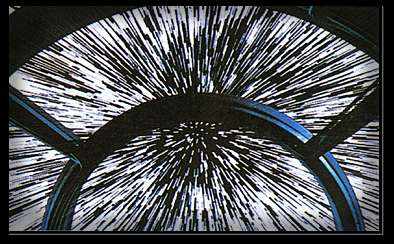
I've always loved space opera, but when I was growing up, as I learned more about science, I discovered that a lot of the tropes in space opera are problematic. Space operas, to tell adventure stories among the stars, often have to make compromises. One of the earliest and most pervasive is FTL (faster than … Continue reading Why faster than light travel is inevitably also time travel
 SelfAwarePatterns