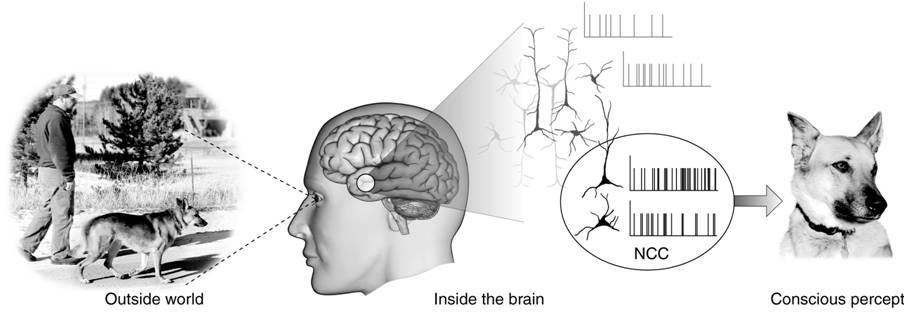
A few years ago it was announced that The Templeton Foundation was funding an adversarial collaboration on theories of consciousness. The initial plan was to pit Global Neuronal Workspace Theory (GNWT) against Integrated Information Theory (IIT), although the initiative plans to move on to other theories once these have been tested.
Early on, I had this observation to make about the effort:
The whole thing has a bit of a publicity stunt feel to it. As I noted back in March, both of these theories make differing philosophical assumptions about what consciousness fundamentally is, and the authors of both theories used empirical data, as it existed at the time, when formulating their theory. So I’m not expecting the results to be overwhelmingly conclusive. (Although it’d be good to be proven wrong on this.)
Well, the results of the first experiments are now in, and they are…inconclusive. Although they reportedly tilt toward IIT’s emphasis on the posterior portions of the brain, enough so that some IIT proponents are declaring victory, and one opponent of GNWT is declaring it dead.
However Christof Koch, a major proponent of IIT, is being more cautious, enough so that he’s conceded his bet with David Chalmers, made 25 years ago, that the neural correlates of consciousness would be known by now.
Chalmers admitted this was always a safer bet for him, particularly since a lot of people think the search for the correlates is misguided, at least the correlates of qualia / phenomenal properties. The reasons for thinking it’s misguided vary, from non-physicalists seeing it as impossible, to illusionists seeing it as looking for the wrong thing. (Keith Frankish pointed out that the biological correlates of the élan vital also remain undiscovered.)
And Stanislas Dehaene, the chief proponent of GNWT, who is actually looking more for the correlates of functional awareness than qualia, had this observation noted in the Science article:
Dehaene says the design of the experiment compromised the sensitivity of signal decoding from the front of the brain that would have supported GNWT. It was, he says, a design that Tononi was keen on. In a trade-off, Dahaene scored his preferred design for the subsequent TWCF-funded experiment, which the research team hopes to present at next year’s ASSC meeting.
In other words, the assumptions behind the design of the experiment are affecting the result, which gets back to the point I made back in 2019.
Although, cards on the table, I’m more sympathetic to GNWT’s assumptions than IIT’s (which I have to admit to not fully understanding, despite having read a fair amount about it). But I also seriously doubt GNWT, or global workspace theories in general, will be the whole picture. They may explain certain aspects of access consciousness, but we will almost certainly need insights from other theories, like Michael Graziano’s Attention Schema Theory and the various predictive coding theories. But that’s admittedly the take of a pragmatic functionalist.
Anyway, it sounds like we have another year before we’ll know the results of the second set of experiments that Dehaene is waiting on. Something tells me those results will still be relative to theory assumptions, essentially to the philosophy behind the theory.
But maybe I’m missing something?
 SelfAwarePatterns
I saw this and figured you would comment on it.
Regarding élan vital, I won’t bother with Frankish’s take on it but I do think the biological correlates of élan vital are known and it is pretty much the same correlates as the correlates for consciousness. It isn’t a substance but it is the low frequency self-generated electrical oscillations that organize and distribute information. When they cease in an organism it is dead. When they cease in a brain, the brain and likely the organism is dead.
I think Northoff is on the right track with temporal nesting of oscillations built on a foundation of low-frequency oscillations. Eventually I hope to have a more detailed examination of Northoff’s Spontaneous Brain and Neurowaves. The temporal nesting supports both GW and IIT in that it provides the mechanism for distribution of information and shows how information is integrated in the brain.
LikeLiked by 1 person
This was kind of hard to avoid commenting on.
On élan vital, of course a lot depends on how we interpret that phrase’s meaning. Bergson reportedly meant something different from the traditional vitalistic force, but if so, his name choice is puzzling. Biology seems to get by without it as a concept.
I don’t know enough about Northoff’s theory to comment intelligently. I probably should just wait until you do your writeup(s). I guess my only question right now would be, what makes the oscillations in biology different from the ones in technology? Or does he see a categorical difference?
I do like that he doesn’t see his theory as the sole and complete answer.
LikeLiked by 1 person
Biology studies these oscillations all the time. It has just never abstracted the concept to a more grandiose declaration of “life force”. Hanson, Reber, and Llinás have all speculated about the origins of consciousness in excitable membranes and oscillations in unicelled organisms. At present, I don’t see much to be gained by the broader abstraction except for it providing perhaps an evolutionary path for explaining how the brain and its oscillations came about.
Northoff’s approach, I think, pulls together the various pieces of other theories with a unification built around the most observable and measurable aspect of the brain we can study – brain waves.
LikeLiked by 1 person
BTW, if you look at the second page of this paper by Northoff and Lamme:
Click to access 3850.pdf
It has a chart that summarizes (10,000 foot level) all the main theories of consciousness including IIT, GNWT, and a couple others including Northoff’s, It seems somewhat apparent from the chart there is agreement on many points across the theories and the differences are frequently a matter of what form of phenomenality and brain activity is the main focus of a theory.
LikeLiked by 1 person
Thanks. Looks like an interesting paper. Although I’m a little suspicious of some of what they’re including as “major” theories. Or that they left off AST, only mentioning an older version of it in the text.
I’m onboard with the idea that many different empirical theories are targeting different valid aspects of what we mean by “consciousness”. But that doesn’t include every theory someone has published.
LikeLike
If the predictions outlined in the report were agreed to by the respective advocates of the theories, I’d say they both took an evidential hit. Of course, there may be other variants of each theory out there, not well represented on whatever committee agreed that these predictions follow from the respective theory.
Stepping back a bit, I don’t get how GNWT and IIT have to be considered rivals. GNWT is tailor made to be a theory of access consciousness. IIT is explicitly billed as a theory of phenomenal consciousness. It’s not a big deal if they work in different ways. It’s as if a cognitive psychologist who specializes entirely in a theory of emotions was somehow considered “opposed” to another who specializes in cognition.
LikeLiked by 2 people
On the predictions, I’d agree if both parties had agreed fully that the procedures were the right ones. But from the article, it sounds like there was some messy horse trading going on, with Dehaene having to compromise on some things he didn’t like this time so he could get methods more to his liking on the next experiment. From Tononi’s standpoint, the later protocol will probably be problematic. To the point you make in the second paragraph, an adversarial match between theories aimed at different things is going to be problematic, no matter what’s hammered out.
All of which makes me wonder about the value of this effort. It’s chief benefit, as I see it, is it calls attention to how difficult it is to even agree on what we’re looking for. Dehaene and Tononi, I think, each think the other is trying to explain the wrong thing.
LikeLiked by 1 person
I think Northoff too would see most of the competing scientific theories as complementary rather than contradictory. Much has been built on task and stimulus oriented research. Northoff argues that is important but also important is resting state brain activity and it takes the full spectrum of activity to explain how the brain does what it does.
LikeLiked by 1 person
Cute story. I think Chalmers should try for two cases of fine wine next time.
LikeLiked by 1 person
I thought it was interesting that the bet dated back to when Koch was working with Francis Crick. I think Koch’s views have evolved a lot since then, veering from Crick’s stone cold materialism, to panpsychism, to something in between with IIT by 2019. He seems keen to do it again, but I wonder if he would have when he wrote his 2012 book.
LikeLike
Wow, I would think that to go from stone cold materialism to panpsychism takes a midlife crisis or a seriously open mind.
On the bet, I’m guessing he enjoys picking out fine wines. 😉
LikeLiked by 1 person
It’s also possible that Crick’s influence was the main thing that kept him in the physicalist camp, and once that influence was gone, he just gravitated toward his own inclinations. His own account, in his 2012 book, is that someone in a talk challenged him to explain how his latest theory at the time was any less of a magic recipe than Descartes’ pineal gland idea. That question apparently haunted him, eventually bringing him to the conclusion that a mechanistic account is impossible.
LikeLiked by 1 person
The preprint has been published: https://www.biorxiv.org/content/10.1101/2023.06.23.546249v1
It’s no easy read, I just skimmed it.
One caveat seems to me to be that the experiments focus mainly on visual perception. In the study, suprathreshold visual stimuli belonging to four different categories (faces, objects, letters, false fonts) were used and presented in different orientations and durations while participants searched for two rare targets. More crucial may be the question of which brain processes underlie conscious emotional experiences such as fear or pain.
I do not see that the results confirm IIT, as Boly et al. purport. As Dehaene well points out: “none of the massive mathematical backbone of IIT, such as the φ measure of awareness, was tested in the present experiment. Instead, what are presented as unique predictions of IIT (posterior visual activation throughout stimulus duration) are just what any physiologist familiar with the bottom-up response properties of those regions would predict, since visual neurons still respond selectively during inattention or general anesthesia.” However, the experimental findings can also be seen as support for higher-order theories of consciousness.
Anyway, it is not comprehensible why, on the basis of anatomical considerations derived from axiomatic assumptions, a posterior complex – the so-called posterior cortical ”hot zone” – can be considered sufficient for conscious experience.
LikeLiked by 1 person
Thanks Karl! I had hoped to at least skim this paper prior to doing the post, but it took forever for it to show up on bioRxiv.
Reading the abstract, it looks like GNWT’s focus on the ignition may be its weak spot, which is an aspect of the theory I’ve always been a bit leery of, thinking that Dennett’s multiple drafts variant, which explicitly abjures any one dramatic point where something enters consciousness, as more plausible. But I definitely need to peruse the rest, particularly the discussion section (assuming they have one).
The thing about higher order theories, is there’s no real doubt that higher order thoughts occur, only whether they are necessary for consciousness. And I often wonder if there’s any real fact of the matter on this. But I think the Templeton effort is supposed to move on to test HOTTs once they’re done with GNWT and IIT.
I’m with you about the hot zone. It seems like a lot is missing, including activation of the hippocampus for memory formation, and affective reactions which seem more centered in the frontal regions. It’s possible that traces of the back processing can make it into very short term memory, but it seems like the other regions are necessary for anything to ever come of it.
LikeLike