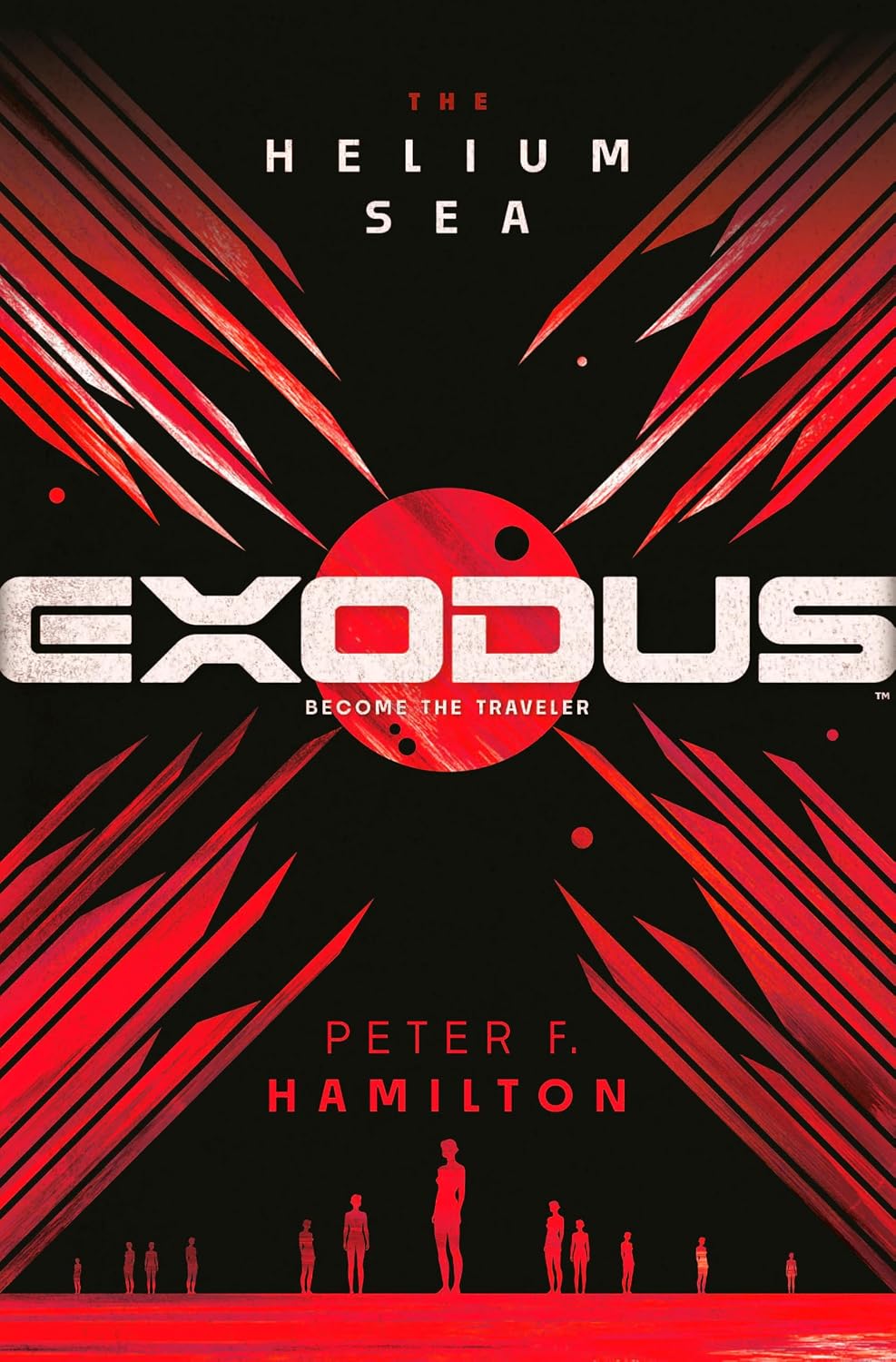
Peter F. Hamilton’s Exodus: The Helium Sea is the second part of a duology that began with Exodus: The Archimedes Engine. It continues the story of humans trying to survive in a star cluster dominated by numerous posthuman species known as Celestials. The Celestials are descendants of the first settlers in the cluster, who arrived tens of thousands of years earlier. The humans in the story are descended from more recent arrivals, and are generally a marginalized class.
In this future, large swathes of humanity fled a dying Earth in relativistic ark ships. Some of those ships discovered habitable worlds in the Centauri Cluster 16,000 light years from Earth, and sent out a “Green Worlds” signal to summon the other arks. But it took 20,000 years for those other arks to arrive, during which time a lot of history happened in the cluster, leading to the development, through genetic engineering, of the Celestials.
Faster than light travel and communication remain impossible. However, a mysterious group of Celestials known as the Elohim have built a network of “Gates of Heaven.” An ingress gate quickly accelerates a ship to near lightspeed, while the egress gate on the other end decelerates the ship back to normal speeds, using lines of “quintessence” from stars for energy. The journey typically lasts a few hours for those on the ship but years for everyone else. Although the Centauri Cluster has millions of systems within a hundred light years of each other, which mitigates the effects somewhat.
There is a class of humans known as “Travelers” who travel the cluster, trading and looking for remnant technology left over from the early wars in the cluster. The nature of their travel makes them increasingly disconnected from their originating societies due to the relativistic effects. And of course Celestials often travel.
There is a group of Celestials who don’t use the gates, instead traveling between the stars, an extremely disturbing society known as the Mara Yama, who often capture humans and other Celestials and torture them, deriving pleasure from their sensations. They are a universally despised and recognized threat.
Most of the story takes place in the Crown Dominion, a matriarchal society ruled by Celestials known as “Imperials” with the ability to transmit memories and learning through touch. When Imperials are about to die, they use this ability to transmit their mind into one of their children, who, when young, have an innate desire to inherit their parent’s “mindline.” Generally this only happens with one child, with the others going on to become “new life.”
It’s established in the story that a mind can be transmitted into more than one body, and that they can be stored in technology. Although both scenarios appear to be rare and unexpected. The implication is that the broader culture frowns upon these types of maneuvers. We also learn that the Imperial mindlines are considered weird by most other Celestials.
The Crown Dominion is one of the few Celestial societies that accept human immigrants, although they’re looked down upon, and basically treated only as an economic resource. Humans aren’t allowed access to most Celestial technologies. While they have decent lives, their development is stuck in stasis.
In the first book, we met Finn, a human son of a wealthy aristocratic family, who has some limited ability to manipulate Celestial technologies. Chaffing under the rules of his family, Finn wants to become a traveler. His opportunity arrives when he meets Eleanor and Josias Aponi from a recently arrived ark ship. In return for providing land for the ark ship passengers to live on, he becomes the ark’s new owner, enabling him to travel the cluster.
However, Finn has become entangled in a conspiracy ultimately engineered by an ancient enemy of the Crown Dominion, with the human population serving as pawns in a game that could well destroy them.
I enjoyed both books immensely. As I noted when reviewing the first one, I’m impressed with Hamilton’s storytelling skills. This second book serves as an excellent conclusion to the story.
My only quip is that it felt like there was a promise in the first book of bigger changes. While the ending in the second book was epic, it wasn’t as epic as I was expecting. To some degree, I shouldn’t be too surprised. These books are based on an upcoming (already released?) role playing game, so there was probably always a limit on what Hamilton would do with the overall Centauri Cluster, although, just within the scope of the Crown Dominion, I was surprised by how quickly things wrapped up.
That said, I enjoyed these books enough that I’ll definitely be looking at some of Hamilton’s other recent books. He knows how to tell a story!
If you’ve read this or any other similar works, would love to hear your thoughts!


I’ve only read his Greg Mandel trilogy and the last book so unimpressed me that I’ve avoided Hamilton ever since.
LikeLiked by 2 people
I do find his early stuff unreadable. The detailed descriptions bog the pace, making it a slog. I know some love that kind of writing, but for me, it’s at best pointless work. Somewhere along the way, his writing appears to have tightened considerably. He still goes into more detail than I care for, but I find it tolerable now. And he does come up with pretty good stories.
LikeLiked by 2 people