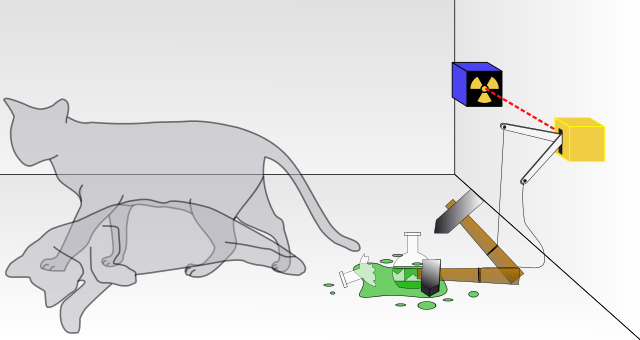
With quantum physics, we have a situation where a quantum object, such as a photon, electron, atom or similar scale entity, acts like a wave, spreading out in a superposition, until we look at it (by measuring it in some manner), then it behaves like a particle. This is known as the measurement problem. Now, … Continue reading The measurement problem, Copenhagen, pilot-wave, and many worlds
Category: Science
Sean Carroll’s Something Deeply Hidden
I'm just about finished reading Sean Carroll's Something Deeply Hidden. I was going to wait to post this until I'd completely finished, but all I've got left is the appendix, I perceive that I've gotten through the main points, and discussion on the previous post is veering in this direction. As widely reported, Carroll is … Continue reading Sean Carroll’s Something Deeply Hidden
Why you can’t use quantum entanglement for faster than light communication
Albert Einstein, with his theory of special relativity, established that the speed of light is the absolute speed limit of the universe. A rocket ship attempting to accelerate to the speed of light encounters some well known effects: time dilation, mass increase, and length contraction. The closer to the speed of light it gets, the … Continue reading Why you can’t use quantum entanglement for faster than light communication
Recommendation: What Is Real?
Last week I started listening to a Sean Carroll podcast episode, an interview of Adam Becker on his book, What Is Real?: The Unfinished Quest for the Meaning of Quantum Physics. Before even finishing the episode, I downloaded Becker's book and read it. Becker starts out in the early decades of the 20th century, when … Continue reading Recommendation: What Is Real?
Neanderthals and the beginnings of us
The Smithsonian has an interesting article up on what we currently know about Neanderthals. The article details some of the internecine battles that always seems to be a part of the paleoanthropology field, in this case focusing on the capabilities of Neanderthals, whether they had art, religion, and other qualities of modern humans. Our view … Continue reading Neanderthals and the beginnings of us
Do all quantum trails inevitably lead to Everett?
I've been thinking lately about quantum physics, a topic that seems to attract all sorts of crazy speculation and intense controversy, which seems inevitable. Quantum mechanics challenges our deepest held most cherished beliefs about how reality works. If you study the quantum world and you don't come away deeply unsettled, then you simply haven't properly … Continue reading Do all quantum trails inevitably lead to Everett?
Are the social sciences “real” science?
YouTube channel Crash Course is starting a new series on what is perhaps the most social of social sciences: Sociology. http://www.youtube.com/watch?v=YnCJU6PaCio The social sciences, such as sociology, but also psychology, economics, anthropology, and other similar fields get a lot of grief from people about not being "real" science. This criticism is typically justified by noting … Continue reading Are the social sciences “real” science?
What do scientific theories actually tell us about the world?
One of the things that's exciting about learning new things, is that often a new understanding in one area sheds light on what might seem like a completely separate topic. For me, information about how the brain works appears to have shed new light on a question in the philosophy of of science, where there has long … Continue reading What do scientific theories actually tell us about the world?
Consciousness is composed of non-consciousness
The components of a thing are not individually the thing. For example, the components of the chair I type most of my blog posts from are not the chair itself, but the wood of the frame, the springs for the back and bottom, some metal parts for the reclining mechanism, the fabric coverings, cushions, etc. … Continue reading Consciousness is composed of non-consciousness
97% of the observable universe is forever unreachable
The other day, I was reading a post by Ethan Siegel on his excellent blog, Starts With a Bang, about whether it makes sense to consider the universe to be a giant brain. (The short answer is no, but read his post for the details.) Something he mentioned in the post caught my attention. But … Continue reading 97% of the observable universe is forever unreachable