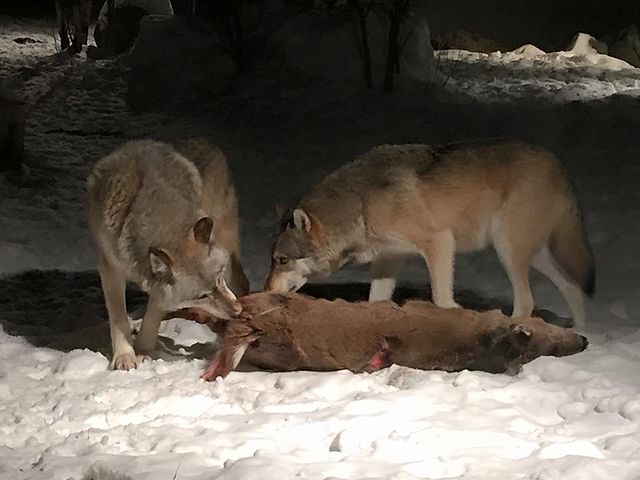
I just finished watching the first three episodes of the new HBO Max series: Raised by Wolves. Lamentably, HBO made this difficult since they've been in a dispute with Roku, my preferred steaming platform, on getting an app into their environment. I had to watch it on as ASUS Chromebook mini I keep connected to … Continue reading Raised by Wolves
The problem with Mary’s room
For some reason, Mary's room has been garnering attention lately. This TED Ed video on it was shared on Aeon's site this week. https://www.youtube.com/watch?v=mGYmiQkah4o The wording of the actual thought experiment is important, so quoting Frank Jackson's words (via the Wikipedia article on the knowledge argument): Mary is a brilliant scientist who is, for whatever reason, … Continue reading The problem with Mary’s room
The facilitation hypothesis
Jonathan Birch has an interesting paper in Noûs: The search for invertebrate consciousness. Birch notes that there is no consensus on whether any invertebrates are conscious, and no agreement on a methodology for establishing whether they are. He starts off assessing the difficulties of applying many human centric theories, such as global workspace, which don't … Continue reading The facilitation hypothesis
Fostering an open mind
There's an interesting article in Psyche: How to foster ‘shoshin’. "Shoshin" is a Japanese Zen word referring to a "beginner's mind." The idea is that when we take ourselves to be a beginner in a subject, or at least still a student of it, we're more open to possibilities. But as we begin to think … Continue reading Fostering an open mind
Dimensions of animal consciousness
The journal, Trends in Cognitive Science, has an interesting paper up: Dimensions of Animal Consciousness. After noting the current consensus that some form of consciousness is present in at least mammals, birds, and cephalopods, it looks at how to evaluate it in various species. The authors take the position that consciousness can be present in … Continue reading Dimensions of animal consciousness
Regular people: What hard problem of consciousness?
The hard problem of consciousness, a term coined by philosopher David Chalmers, asks how physical systems can produce phenomenal consciousness. Chalmers' term, coined in the 1990s, applied to an older problem that's been around for along time, the mind-body problem. More recently, Chalmers noted his intuition that the hard problem is widely and intuitively held … Continue reading Regular people: What hard problem of consciousness?
The blogging experience at 1000 posts
Yes, this is the 1000th post here on SelfAwarePatterns. I started this blog in November, 2013, largely from two motivations. One was because I had done Nanowrimo the previous November. (Nanowrimo is a challenge to write a novel in a month. Worth checking out if you've ever had that ambition.) I felt bad about not … Continue reading The blogging experience at 1000 posts
The complex composition of pain
When I was very young, the top of my feet started itching, so I started scratching. The itching continued for weeks and months, with me constantly scratching. My poor mother, seeing my red and scratched feet, implored me to stop. But the itching was relentless and I was maybe five or six, so I kept … Continue reading The complex composition of pain
What do alien civilizations look like from afar?
This is a pretty good description of the Kardashev Scale of civilization energy usage. https://www.youtube.com/watch?v=rhFK5_Nx9xY I initially thought the video overestimated how close we are to being a Type I civilization, but then I remembered that the whole scale is logarithmic, so maybe not. It also mentioned that we might "choose" to build a megastructure … Continue reading What do alien civilizations look like from afar?
The Elflord and the Mayfly
I found this Existential Comic interesting for its insight on what things might be like for J.R.R. Tolkien's version of elves. The author, on Twitter, shared a short video on Tolkien's thoughts on death. If you're familiar with the mythology behind The Lord of the Rings, as revealed in The Silmarillion and other works, the … Continue reading The Elflord and the Mayfly