Someone asked for my thoughts on an argument by Sean Dorrance Kelly at MIT Technology Review that AI (artificial intelligence) cannot be creative, that creativity will always be a human endeavor. Kelly's main contention appears to be that creativity lies in the eye of the beholder and that humans are unlikely to recognize AI accomplishments … Continue reading AI and creativity
Synthetic DNA and the necessity of biological mechanisms
Scientists have created synthetic DNA with four extra "letters": A couple billion years ago, four molecules danced into the elegant double-helix structure of DNA, which provides the codes for life on our planet. But were these four players really fundamental to the appearance of life — or could others have also given rise to our genetic code? … Continue reading Synthetic DNA and the necessity of biological mechanisms
The real issues with colonizing space
At Nautilus, Phil Torres argues that we should think twice about colonizing space. His reasoning appears to be that as we spread throughout the universe, we will undoubtedly diversify into different species, and that those species may come to distrust each other, and eventually try to destroy each other. Now, I've argued before that most … Continue reading The real issues with colonizing space
What’s at the edge of the universe?
Gizmodo has an interesting article that someone asked my thoughts on. Part of their "Giz asks" series, it asks various physicists what's at the edge of the universe? The physicists polled include Sean Carroll, Jo Dunkley, Jessie Shelton, Michael Troxel, Abigail Vieregg, and Arthur B. Kosowsky. They all give similar answers, that space isn't known … Continue reading What’s at the edge of the universe?
Maybe the brain communicates via electrical fields after all
An interesting finding by scientists at Case Western Reserve University, that neurons may communicate via electrical fields: Scientists think they've identified a previously unknown form of neural communication that self-propagates across brain tissue, and can leap wirelessly from neurons in one section of brain tissue to another – even if they've been surgically severed. ...To … Continue reading Maybe the brain communicates via electrical fields after all
Did smell lead to consciousness?
Smell has apparently always been a peculiar sense. The sensory pathway of smell information to the brain runs completely independent from the other senses. The pathways for the other senses run through the midbrain and thalamus and are then relayed to cortical regions. But smell goes to the olfactory bulb behind the nose, and from … Continue reading Did smell lead to consciousness?
When does personhood begin?
Gary Whittenberger has an article at Skeptic on discussing personhood and abortion: The pro-person position, as I have outlined it in this essay, recognizes the late fetus and the host woman both as persons with human rights. When these rights come into conflict, as can occur during the last 15 weeks of pregnancy, then the … Continue reading When does personhood begin?
Why are we real?
Nathaniel Stein has an interesting article at Aeon, The why of reality: The easy question came first, a few months after my son turned four: ‘Are we real?’ It was abrupt, but not quite out of nowhere, and I was able to answer quickly. Yes, we’re real – but Elsa and Anna, two characters from Frozen, … Continue reading Why are we real?
Is the brainstem conscious?
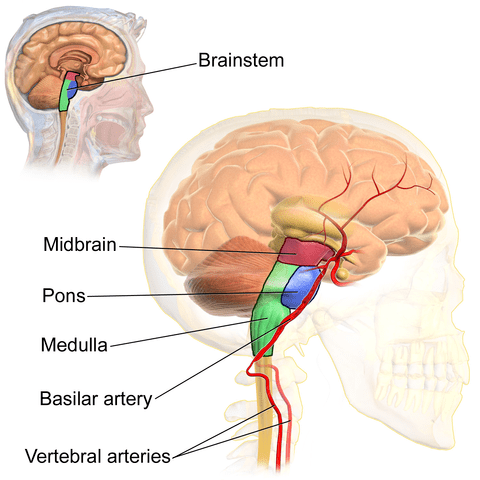
(Warning: neuroscience weeds and references to gruesome animal research.) The vast majority of neuroscientists see consciousness as a cortical phenomenon. It may be crucially dependent on sub-cortical and sub-cerebral structures, but subjective experience itself exists mainly or entirely in the neocortex. In this view, the brainstem only produces reflex responses, with anything more sophisticated coming … Continue reading Is the brainstem conscious?
Strong vs weak emergence
The Neuroskeptic has an interesting post on a paper challenging theories of mind based on strong emergence. A new paper offers a broad challenge to a certain kind of ‘grand theory’ about the brain. According to the authors, Federico E. Turkheimer and colleagues, it is problematic to build models of brain function that rely on ‘strong … Continue reading Strong vs weak emergence

