I'm sure anyone who's paid attention to my science fiction novel recommendations has noticed that I love space opera. But as much as I love the genre, I'm often aware of an issue many of its stories have. In order to have the characters be in jeopardy, they often ignore the implications of artificial intelligence. … Continue reading Recommendation: The Roboteer Trilogy
Having productive internet conversations
Anyone who's frequented this blog knows I love having discussions, and can pontificate all day on subjects I'm interested in. I've actually been participating in online discussions, on and off, for decades. My earliest conversations were on dial up bulletin boards. Those were usually tightly focused discussions about technology and gaming. With the rise of … Continue reading Having productive internet conversations
The system components of pain

Peter Hankins at Conscious Entities has a post looking at the morality of consciousness, which is a commentary on piece at Nautilus by Jim Davies on the same topic. I recommend reading both posts in their entirety, but the overall gist is that which animals or systems are conscious has moral implications, since only conscious … Continue reading The system components of pain
Predicting far future technologies
Prediction is very difficult, especially about the future. Niels Bohr If you're a science fiction writer, one of the things you do is try to predict what future technologies will come along. If you're not writing hard science fiction, this is relatively easy. You just come up with a cool capability and throw in some … Continue reading Predicting far future technologies
Why embodiment does not make mind copying impossible
A while back, I highlighted a TEDX talk by Anil Seth where he discussed that cognition is largely a prediction machine. Apparently Seth more recently gave another talk at the full TED conference, which is receiving rave reviews. Unfortunately, that talk doesn't appear to be online yet. But one article reviewing the talk focuses on something … Continue reading Why embodiment does not make mind copying impossible
Recommendation: Dark Intelligence
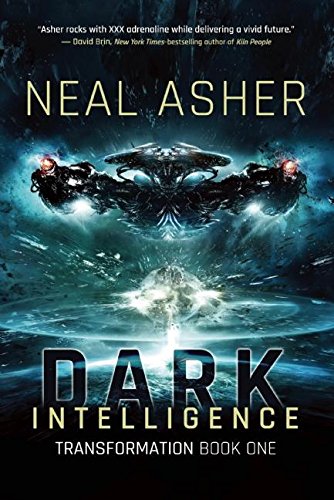
I've been meaning to check out Neal Asher's books for some time. They keep coming up as recommendations on Amazon, Goodreads, and in various other venues, and they sound enticing, like the kind of fiction I'd enjoy. Last week, I finally read the first book of his most recent trilogy, 'Dark Intelligence'. The universe described … Continue reading Recommendation: Dark Intelligence
Steven Pinker: From neurons to consciousness
This lecture from Steven Pinker has been around for a while, but it seems to get at a question a few people have asked me recently: how does the information processing of neurons and synapses lead to conscious perception? Pinker doesn't answer this question comprehensively (that would require a vast series of lectures), but he answers facets of … Continue reading Steven Pinker: From neurons to consciousness
Is consciousness only in the back of the brain?

There's an interesting debate going on among some neuroscientists about which parts of the brain are involved in subjective experience. On the one side are Christof Koch, Giuilio Tononi, and colleagues who argue that consciousness exists wholly in the back of the brain, that the frontal structures are not involved. On the other side are neuroscientists … Continue reading Is consciousness only in the back of the brain?
The success of John Scalzi’s descriptive minimalism
One of the categories here on the blog is Science Fiction, mainly because I read and watch a lot of it. Occasionally, someone wanting to get into the literary version of the genre asks me for recommendations on good initial books to start with. My recommendation often depends on the person, but I frequently suggest they try … Continue reading The success of John Scalzi’s descriptive minimalism
Why fears of an AI apocalypse are misguided
In this Big Think video, Steven Pinker makes a point I've made before, that fear of artificial intelligence comes with a deep misunderstanding about the relationship between intelligence and motivation. Human minds come with survival instincts, programmatic goals hammered out by hundreds of millions of years of evolution. Artificial intelligence isn't going to have those … Continue reading Why fears of an AI apocalypse are misguided

