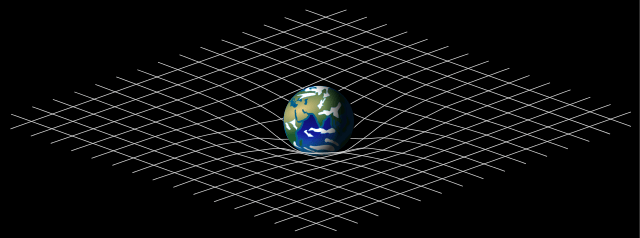
A new approach for reconciling general relativity and quantum mechanics proposes adding some randomness in general relativity, making it less deterministic on small scales. For several decades, physicists have been trying to reconcile general relativity and quantum mechanics. These theories, despite each having been empirically validated to several decimal places, contradict each other. The problem … Continue reading What would randomness in general relativity mean?
Tag: General relativity
A PBS Space Time series on time and the block universe
Somewhat related to the previous post, I just saw this video from Matt O'Dowd discussing why the block universe is such a compelling concept. https://www.youtube.com/watch?v=EagNUvNfsUI&t=12s The second video in the series discusses the effect quantum mechanics might have on this concept. It reminds me why cosmologists seem to be more comfortable with the Many Worlds … Continue reading A PBS Space Time series on time and the block universe
The block universe is interesting, but not comforting
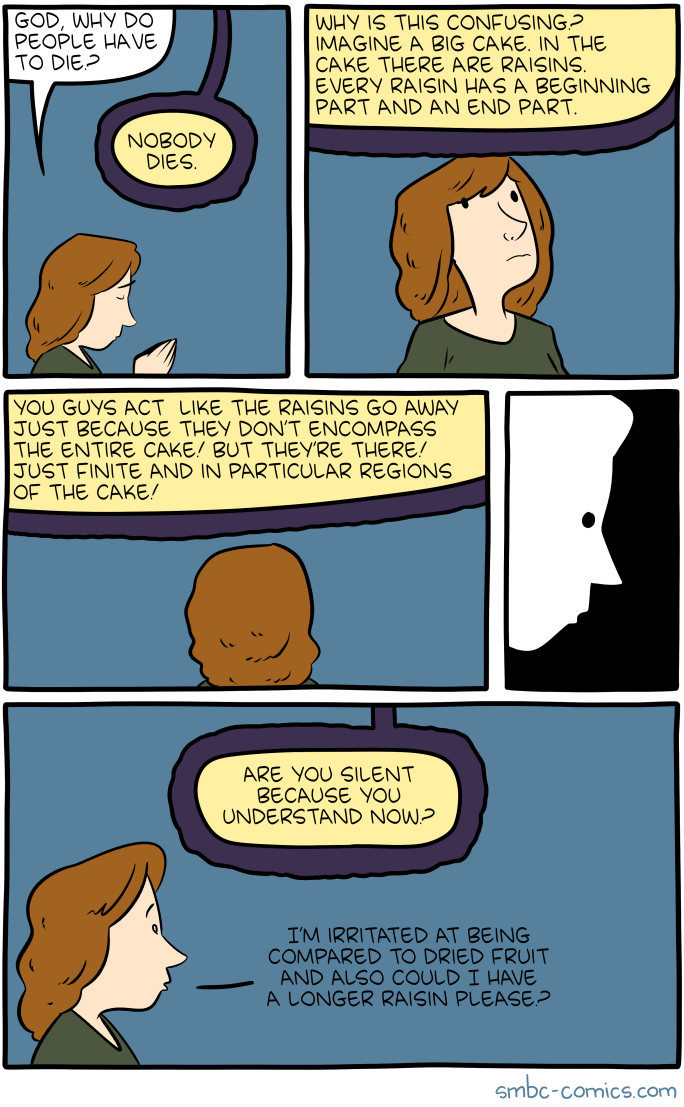
Click through for source and bonus red button caption at smbc-comics.com. This SMBC gets at something that's often bothered me about the way many people talk about the block universe concept. The block universe is the idea that if the universe is fully deterministic, then its entire history from beginning to end exists in an … Continue reading The block universe is interesting, but not comforting
In case you haven’t heard yet, gravitational waves have been detected
I won't attempt to describe the implications. For that, your best bet is to read it from one of the experts, Ethan Siegel: The First Detection Of Gravitational Waves Validates Einstein In A Whole New Way! Let's hope those implications aren't this. Source: xkcd Both General Relativity and the Standard Model or particle physics keep getting … Continue reading In case you haven’t heard yet, gravitational waves have been detected
Dark matter might cause neutron stars to collapse into black holes
ratamacue0 called my attention to this interesting article on the possibility of dark matter "eating" neutron stars: Dark matter: Devourer of stars | Ars Technica. Neutron stars are collapsed stars that have used up all of their fusion fuel. Typically what happens at that point in a star's life is that they collapse, but the extent of … Continue reading Dark matter might cause neutron stars to collapse into black holes
The movie ‘Interstellar’ and wormholes
The other day, I did a post on interstellar exploration which linked to one by Sten Odenwald on the problems with interstellar travel. Well, he posted some follow-up remarks, expressing some surprise at the response, doubling down on the aspects of the limitations of interstellar travel he identified, and urging people to be optimistically realistic. (I predict he'll get … Continue reading The movie ‘Interstellar’ and wormholes
Reaching the stars will require serious out-of-the-box thinking
Sten Odenwald, an astronomer with the National Institute of Aerospace, has an article up at HuffPost that many will find disheartening: The Dismal Future of Interstellar Travel | Dr. Sten Odenwald. I have been an avid science fiction reader all my life, but as an astronomer for over half my life, the essential paradox of my fantasy world can … Continue reading Reaching the stars will require serious out-of-the-box thinking
Primers on detecting primordial gravity waves and cosmic inflation
First, Minute Physics takes a shot at explaining what the BICEP2 team actually found and how it relates to gravitational waves. I think I'm going to have to watch this a second time to pick up everything. http://www.youtube.com/watch?v=4IlBNJbCzfk And Ethan Siegel has an in-depth discussion of cosmic inflation at his Starts With A Bang site.
First Direct Evidence of Cosmic Inflation – SpaceRef
Wow! There were lots of rumors about this over the weekend. Turns out that, in this case, the rumors were spot on. Almost 14 billion years ago, the universe we inhabit burst into existence in an extraordinary event that initiated the Big Bang. In the first fleeting fraction of a second, the universe expanded exponentially, … Continue reading First Direct Evidence of Cosmic Inflation – SpaceRef
Searching for empirical anomalies
Ars Technica has an article about the most accurate measurement yet of the mass of the electron. It was an interesting article, particularly in describing how the scientists went about making the measurement. But I was struck by something said at the end: Physicist know that the Standard Model—great for explaining the world of the … Continue reading Searching for empirical anomalies