I've been reading Gerhard Roth's The Long Evolution of Brains and Minds. This a technical and, unfortunately, expensive book, not one aimed at general audiences, but it has a lot of interesting concepts. A couple that Roth mentions are the terms "sensorium" and "motorium." The sensorium refers to the sum total of an organism's perceptions, … Continue reading The sensorium, the motorium, and the planner
Tag: Mind
Did smell lead to consciousness?
Smell has apparently always been a peculiar sense. The sensory pathway of smell information to the brain runs completely independent from the other senses. The pathways for the other senses run through the midbrain and thalamus and are then relayed to cortical regions. But smell goes to the olfactory bulb behind the nose, and from … Continue reading Did smell lead to consciousness?
When does personhood begin?
Gary Whittenberger has an article at Skeptic on discussing personhood and abortion: The pro-person position, as I have outlined it in this essay, recognizes the late fetus and the host woman both as persons with human rights. When these rights come into conflict, as can occur during the last 15 weeks of pregnancy, then the … Continue reading When does personhood begin?
Is the brainstem conscious?
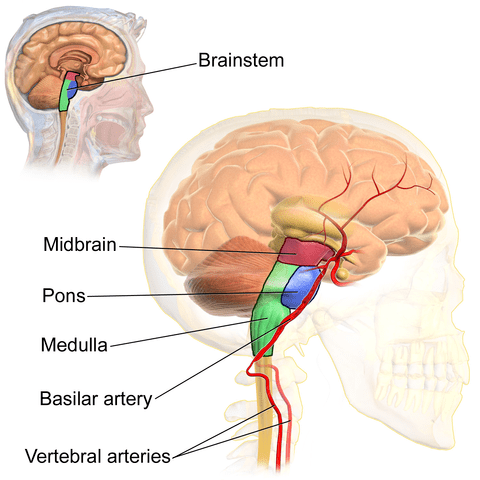
(Warning: neuroscience weeds and references to gruesome animal research.) The vast majority of neuroscientists see consciousness as a cortical phenomenon. It may be crucially dependent on sub-cortical and sub-cerebral structures, but subjective experience itself exists mainly or entirely in the neocortex. In this view, the brainstem only produces reflex responses, with anything more sophisticated coming … Continue reading Is the brainstem conscious?
Strong vs weak emergence
The Neuroskeptic has an interesting post on a paper challenging theories of mind based on strong emergence. A new paper offers a broad challenge to a certain kind of ‘grand theory’ about the brain. According to the authors, Federico E. Turkheimer and colleagues, it is problematic to build models of brain function that rely on ‘strong … Continue reading Strong vs weak emergence
Consciousness lies in the eye of the beholder
There are few things that everyone who ponders consciousness can agree on. It's a topic where debates on the very definition of the subject are common. The only definitions that seem to command near universal assent are the ones oriented toward phenomenology, such as "subjective experience" or "something it is like." And even then, the … Continue reading Consciousness lies in the eye of the beholder
Is it time to retire the term “artificial intelligence”?
Eric Siegel at Big Think, in a new "Dr. Data Show" on the site, explains Why A.I. is a big fat lie: 1) Unlike AI, machine learning's totally legit. I gotta say, it wins the Awesomest Technology Ever award, forging advancements that make ya go, "Hooha!". However, these advancements are almost entirely limited to supervised machine learning, … Continue reading Is it time to retire the term “artificial intelligence”?
The implications of embodied cognition
Sean Carroll on his podcast interviewed Lisa Aziz-Zadeh on embodied cognition: Brains are important things; they’re where thinking happens. Or are they? The theory of “embodied cognition” posits that it’s better to think of thinking as something that takes place in the body as a whole, not just in the cells of the brain. In … Continue reading The implications of embodied cognition
A qualified recommendation: Consciousness Demystified

A couple of years ago I did a series of posts inspired by Todd Feinberg and Jon Mallatt's excellent The Ancient Origins of Consciousness, a book on the evolution of animal consciousness. Somewhat building on what I had read in Antonio Damasio's Self Comes to Mind, it was a pivotal point in my exploration of … Continue reading A qualified recommendation: Consciousness Demystified
Is consciousness a thing or a process? Yes.
I came across this tweet by Amanda Gefter: https://twitter.com/AmandaGefter/status/1083749205531942913 William James, the founder of American psychology was an illusionist? I only read the opening portions of the essay, but it appears so. However, even in 1904, illusionism, the belief that consciousness isn't what it seems, was a very nuanced thing: To deny plumply that 'consciousness' … Continue reading Is consciousness a thing or a process? Yes.
 SelfAwarePatterns