Amanda Gefter has an article at Nautilus a couple of you have asked me about: Reality Exists Without Observers? Boooo! The title is an accurate summary of her thesis. Gefter is responding to a book by Vlatko Vedral, where he reportedly argues for a reality that doesn't require observers. In terms of quantum mechanics, Vedral … Continue reading Does reality require observers?
Tag: Science
Does consciousness require biology?
Ned Block has a new paper out, for which he shared a time limited link on Bluesky. He argues in the paper that the "meat neutral" computational functionalism inherent in many theories of consciousness neglect what he sees as a compelling alternative: that the subcomputational biological realizers underlying computational processes in the brain are necessary … Continue reading Does consciousness require biology?
What physicists believe about quantum mechanics
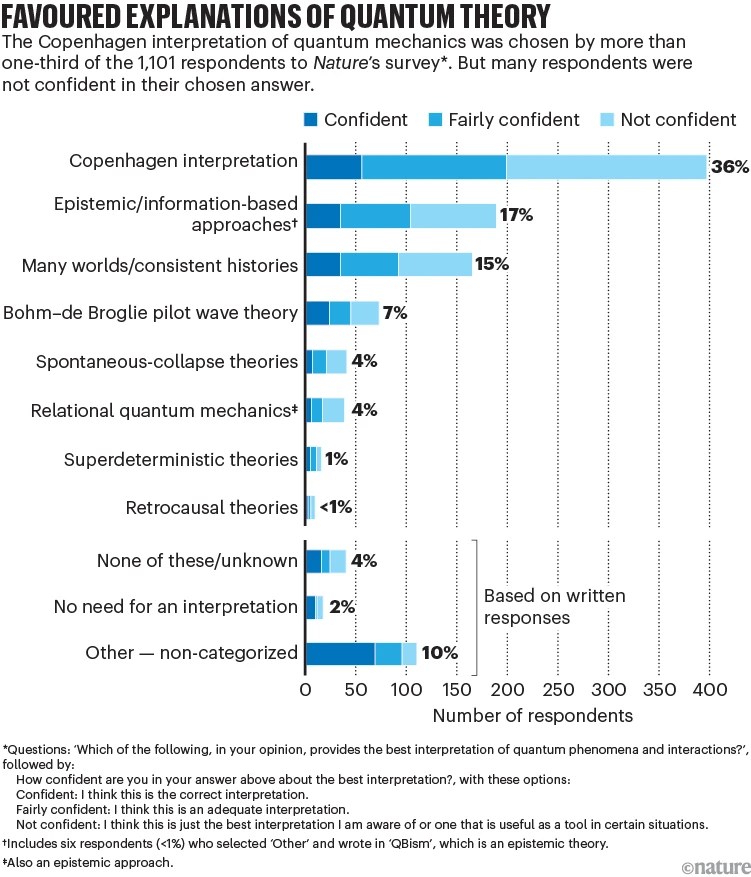
A few years ago David Bourget and David Chalmers did a follow up survey to the 2009 one polling philosophers on what they believe about various questions. One of them was quantum mechanics, particularly the measurement problem and its various interpretations. Over the decades there have been surveys of physicists themselves on this question, but … Continue reading What physicists believe about quantum mechanics
Is quantum immortality a real thing?
In discussions about the Everett interpretation of quantum mechanics, one of the concerns I often see expressed is for the perverse low probability outcomes that would exist in the quantum multiverse. For example, if every quantum outcome is reality, then in some branches of the wave function, entropy has never increased. In some branches, quantum … Continue reading Is quantum immortality a real thing?
Many-worlds without necessarily many worlds?
IAI has a brief interview of David Deutsch on his advocacy for the many-worlds interpretation of quantum mechanics. (Warning: possible paywall.) Deutsch has a history of showing little patience with other interpretations, and this interview is no different. A lot of the discussion centers around his advocacy for scientific realism, the idea that science is … Continue reading Many-worlds without necessarily many worlds?
Avoiding the structural gaps
A long standing debate in quantum physics is whether the wave function is real. A quick reminder: quantum entities appear to move like waves, including portions interfering with each other. These waves are modeled with the wave function. But once measured, quantum objects manifest as localized points or field excitations. The wave function can't predict … Continue reading Avoiding the structural gaps
Where are the aliens?
Among my earliest memories are the TV series Star Trek and Lost in Space, two shows that promised a universe teeming with alien life, intelligent life. As a boy, the aliens seemed everywhere. We'd probably find some on Mars and Venus, and there wasn't much doubt we'd find them in other solar systems. And that … Continue reading Where are the aliens?
Why I’m an ontic structural realist
Scientific realism vs instrumentalism A long standing debate in the philosophy of science is about what our best scientific theories tell us. Some argue that they reveal true reality, that is, they are real. Others that scientific theories are only useful prediction frameworks, instruments useful in the creation of technology, but that taking any further … Continue reading Why I’m an ontic structural realist
Mind uploading and continuity
As a computational functionalist, I think the mind is a system that exists in this universe and operates according to the laws of physics. Which means that, in principle, there shouldn't be any reason why the information and dispositions that make up a mind can't be recorded and copied into another substrate someday, such as … Continue reading Mind uploading and continuity
Entropy transformers
What is the relationship between information, causation, and entropy? The other day, I was reading a post from Corey S. Powell on how we are all ripples of information. I found it interesting because it resonated with my own understanding of information (i.e. it flattered my biases). We both seem to see information as something … Continue reading Entropy transformers