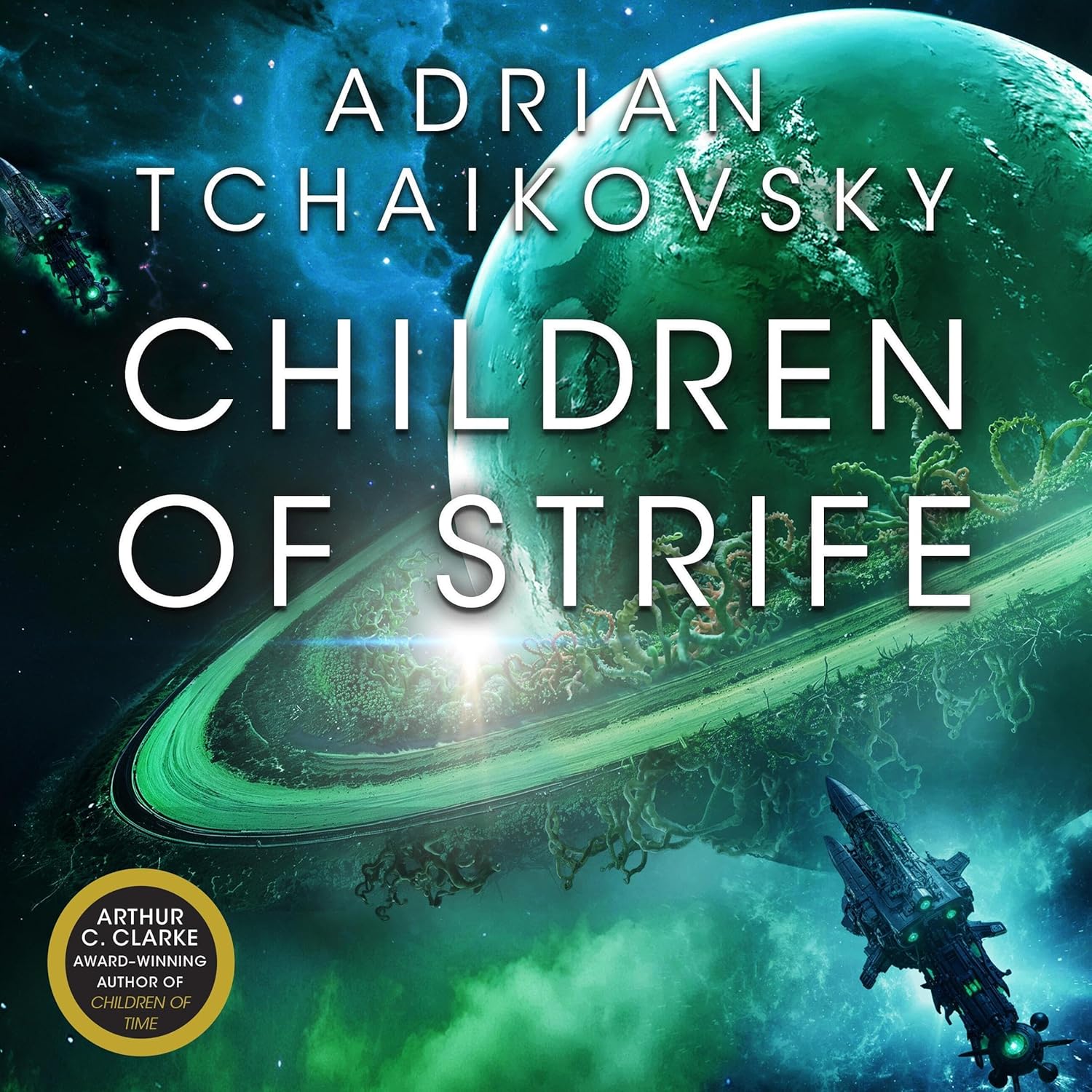
Adrian Tchaikovsky’s Children of Time books are about exploring different types of minds. In the first book he looked at spider minds, specifically uplifted Portia spiders. In the second it was octopuses and an alien group mind. In the third it was mated birds and another type of mind. In Children of Strife, he continues this theme, looking at the minds of uplifted mantis shrimp and other minds uploaded in new ways.
The book starts out reminding us of the history in this universe. The First Age is implied to be a continuation of our current civilization. It sends terraforming projects out to various exoplanets to prepare new worlds for human habitation. However, a catastrophic war breaks out on Earth, ending that civilization. One of the final acts of that war is to send a computer virus that destroys the systems of the terraforming projects, leading most of them to fail.
In the Second Age, thousands of years later, humanity manages to rebuild a civilization again back on Earth. However, the planet is now poisoned and it’s recognized that extinction is inevitable. They discover records of the terraforming projects and gamble on sending ark ships out to those worlds. Most of these missions also fail. Although in the first book, one reaches the world of uplifted spiders, and eventually its crew become the start of a new revised species, Humans (with a capital H), who are able to exist without warfare.
That leads to the Third Age, an age of exploration, with a new civilization, the Panspecific, where multiple species: spiders, Humans, and, later, octopuses, a distributed alien intelligence, mated birds, and mantis shrimp, all exist in an anarchist multispecies society that approaches being a post-scarcity utopia. “Approaches” is important here, because the new book reveals there are pockets of serious issues. It’s a universe populated mostly with descendants of Earth biology, but with many of the other species uplifted or force-evolved into intelligence.
Like the earlier books, this one has threads in multiple ages. The one in the First Age focuses on a group of backbiting tech moguls in orbit around an exoplanet attempting to terraform it, but running into trouble getting its biosphere going. Eventually one of them figures out a way to jumpstart an accelerated evolution, but it requires guidance, guidance they can provide with their minds interfaced into the biosphere.
The Second Age portion gives us a glimpse of what Earth looks like for the civilization building the arks. The entire society seems organized around preserving the species, principally with the ark missions. When the chief engineer of an ark witnesses her ship get destroyed, she’s given a second chance as captain of another ark, one going to a world that had previously been overlooked, a world worked on by a different group from the others. We follow this ark in their thousand year journey and what they encounter when they reach the world left by the tech moguls.
The Third Age starts with Alis, a woman recovering from spending more than a subjective lifetime in a simulation. She’s struggling to accept reality. Her captain is Cato, a human-sized mantis shrimp who struggles with the combative nature of his species, and in communicating with Alis. They are supported by Kern, a First Age scientist who was initially uploaded into a computer system, then later transferred into the ant based computer systems of the spiders.
Alis gradually learns that the rest of her crewmates are in trouble, and a rescue mission is necessary. What follows is an exploration of the planet terraformed in the First Age, and then later colonized by the ark ship, a world where the Life there has a will of its own, one where the humans live a precarious existence in an actively capricious and hostile world.
It’s difficult to go much further without getting into spoilers. Like the earlier books, it’s a pretty thrilling story. Tchaikovsky explores the idea of mind uploading in new ways. While, early in the series, he does posit a technological solution for it, he largely downplays it in favor of uploading into alternate biological substrates. Kern exists in the ant colony computers of the spiders. Many Humans elect to have their minds copied into the alien group intelligence. And before the story is done, a couple of characters end up being uploaded and merged together into the ant substrate.
But also like the others books, this one has a ton of interior monologue, particularly in the early chapters. There are long stretches with no dialogue, just characters ruminating, especially in the First Age portions. Since the theme is exploring minds, many will find this an attraction. But at times it was repetitive, and I often found it tedious. Tchaikovsky does make it pay off in the end, but, at least for me, it required an upfront effort.
Overall I enjoyed the book and recommend it. If you haven’t read the other books, I’m not sure I’d start here. Tchaikovsky does provide a primer at the beginning if you want to, but you’ll still be missing a lot of context from the earlier books.
Have you read it? Or any of the other books in the series? If so, what did you think?
 SelfAwarePatterns
I got it, read to the start of Alis’ story, and decided I rally don’t care about anybody in this story yet. Was gonna give it to one of my kids so they could tell me if I should keep reading or not. So your saying it gets better?
LikeLiked by 2 people
I’d say the Second and Third Age parts get better, although the Third Age parts with Alis do take longer than I like for us to understand what’s going on. The First Age parts overall take too long to tell their story, but it eventually becomes crucial to the stuff in the other ages. The heavy interiority does last throughout the book, so I could see some deciding it’s not their cup.
LikeLiked by 1 person