Lux Alpstraum at Undark argues against "Our Irrational Fear of Sexbots": When most people envision a world where human partners are abandoned in favor of robots, the robots they picture tend to be reasonably good approximations of flesh-and-blood humans. The sexbots of “Westworld” are effectively just humans who can be programmed and controlled by the … Continue reading The dangers of artificial companionship
Tag: Science fiction
Doctor Who: The Woman Who Fell to Earth
I've noted before that I'm a long time fan of Doctor Who, so naturally I tuned in to watch the first episode of the new Doctor played by Jodie Whittaker. I'll be honest here, I wasn't sure what to expect with a female Doctor. As a progressive, I was certainly for it in principle, but … Continue reading Doctor Who: The Woman Who Fell to Earth
A qualified recommendation: The Murderbot Diaries
I'm generally not a fan of most depictions of AI (artificial intelligence) in science fiction. They're often highly anthropomorphic, assuming that engineered intelligences would innately have motivations and impulses similar to humans or other living systems, such as caring about their own survival, social status, or self actualization. A good example of this is the … Continue reading A qualified recommendation: The Murderbot Diaries
Recommendation: Children of Time
The Fermi Paradox is the observation that if intelligent life is pervasive in the universe, it should have arrived on Earth ages ago, but there is no evidence it ever did. The solutions to the paradox include the possibilities that interstellar travel is impossible (or so appallingly difficult that no one bothers), that there is … Continue reading Recommendation: Children of Time
Altered Carbon
Several years ago, I read Richard K. Morgan's Takeshi Kovacs novels about a future where people's minds are recorded in a device (called a "stack") implanted just below the brain stem, essentially providing a form of mind uploading, and allowing people to survive the death of their body. Kovacs, the protagonist of the series, is an … Continue reading Altered Carbon
Recommendation: We Are Legion (We Are Bob)
One of the things that many space enthusiasts find frustrating about the space age is how slow it's moving, at least relative to its early years. Humans made it to the moon almost 50 years ago, but since then seem to have retreated to low Earth orbit, working in space stations just above the atmosphere. … Continue reading Recommendation: We Are Legion (We Are Bob)
Recommendation: The Roboteer Trilogy
I'm sure anyone who's paid attention to my science fiction novel recommendations has noticed that I love space opera. But as much as I love the genre, I'm often aware of an issue many of its stories have. In order to have the characters be in jeopardy, they often ignore the implications of artificial intelligence. … Continue reading Recommendation: The Roboteer Trilogy
Predicting far future technologies
Prediction is very difficult, especially about the future. Niels Bohr If you're a science fiction writer, one of the things you do is try to predict what future technologies will come along. If you're not writing hard science fiction, this is relatively easy. You just come up with a cool capability and throw in some … Continue reading Predicting far future technologies
Recommendation: Dark Intelligence
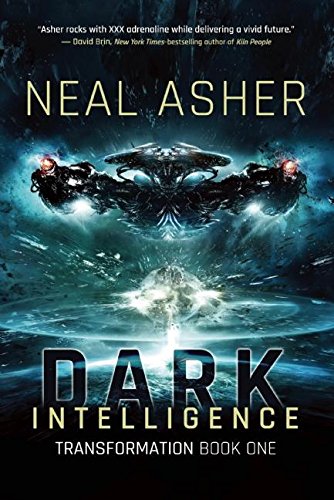
I've been meaning to check out Neal Asher's books for some time. They keep coming up as recommendations on Amazon, Goodreads, and in various other venues, and they sound enticing, like the kind of fiction I'd enjoy. Last week, I finally read the first book of his most recent trilogy, 'Dark Intelligence'. The universe described … Continue reading Recommendation: Dark Intelligence
The success of John Scalzi’s descriptive minimalism
One of the categories here on the blog is Science Fiction, mainly because I read and watch a lot of it. Occasionally, someone wanting to get into the literary version of the genre asks me for recommendations on good initial books to start with. My recommendation often depends on the person, but I frequently suggest they try … Continue reading The success of John Scalzi’s descriptive minimalism
 SelfAwarePatterns